Classical / Baroque · 1936–39
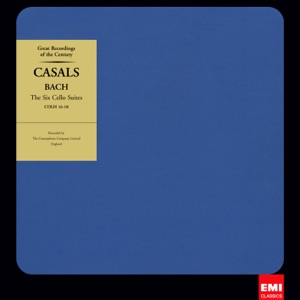
Bach: Cello Suites
Pablo Casals
바흐: 무반주 첼로 모음곡 · 파블로 카잘스
Why listen
One cello suggests several musical roles, while Casals makes each phrase feel directed rather than merely continuous.
Listen and read
Tracks · previews
English editorial edition
Album story
A low note can remain in the memory while the cello moves above it, suggesting a foundation that is no longer literally sounding. Casals adds another kind of continuity: phrases seem to lean towards particular notes and breathe after them. Following that movement is a more revealing introduction than treating the recording as a venerable monument.
Bach’s eighteenth-century compositions and this twentieth-century performance are separate histories. Casals recorded Suites 2 and 3 in 1936,1 and 6 in 1938, and 4 and 5 in 1939. They circulated on 78 rpm records before later complete editions brought them together. The linked EMI digital compilation contains all thirty-six movements; its 2010 release date and 2012 compilation copyright do not date the performances.
Unaccompanied does not mean unsupported
A bass note, a moving upper line and a chord can suggest different roles within a single instrument. Casals shifts weight towards the destination of a phrase and allows the pulse some flexibility. Listen for that direction rather than expecting every repeated shape to receive identical emphasis. The result need not be measured against a modern ideal of evenness to become intelligible as a set of performing choices.
Stay beyond the familiar opening
The first Prelude is an entrance, not a summary of the entire cycle. Each suite continues through movements derived from dances, including the Allemande, Courante and Sarabande. Their changing patterns of weight remain meaningful even when nobody is literally dancing. Hear one suite at a time, comparing the quicker movements with the space of a slow one. In the fifth suite’s Sarabande, the time after a note can seem as consequential as the note itself.
An achievement without a discovery myth
The Library of Congress cautions against claiming that Casals rescued entirely unknown music: nineteenth-century cellists already knew the suites. His importance lies in making their musical value compelling in performance. A specific original-release review has not been established here. Later recognition includes Ralph Moore’s 2010 reissue appraisal, which considered interpretation alongside old recording sound, and selection for the National Recording Registry in 2018. Those later judgements should encourage attentive listening, not replace it.
The album through its tracks
Continue beyond Suite 1’s Prelude into its dances, then compare the sparse Sarabande of Suite 5.
Cello Suite No. 1 in G Major, BWV 1007: I. Prélude
The opening patterns let one cello imply both a foundation and a line moving above it. Begin by finding the returning lower notes, then follow how far the intervening motion reaches. Casals gives the repetitions direction through changes of weight rather than presenting them as identical units. This performance was recorded in 1938 and opens the linked programme. Continue directly into the Allemande afterwards: the contrast between an unfolding introduction and a more recognisable dance step makes the Prelude’s role clearer. Surface noise need not become the main event. Concentrating on where a phrase seems to be going helps bring the playing, rather than its age, into focus.
Reference · Warner Music Japan: original session dates and complete suite listingCello Suite No. 5 in C Minor, BWV 1011: IV. Sarabande
Compared with the first Prelude’s busy surface, this movement makes a few notes occupy a large space. Listen to how long a sound is held and how the next one changes your memory of it. The 1939 performance appears at track twenty-eight in this edition. On a first hearing, follow the line; on a second, attend to the intervals of time between notes. A sarabande comes from dance, but here its weight is more useful to follow than an imagined quick step. Hearing the surrounding movements afterwards clarifies the special space this restrained passage creates within the suite, rather than making it an isolated statement of solemnity.
Reference · Warner Music Japan: original session dates and complete suite listing
Listen next
Trevor Pinnock’s Vivaldi L’estro armonico offers a contrast between solo and ensemble approaches to Baroque pulse and dialogue.
Vivaldi: L'estro armonico Op. 3 ↗References & editorial note
Written for English readers. Album facts are referenced below; listening suggestions are editorial interpretations. AI-assisted editorial review; not independently human-reviewed.
- Warner Music Japan: original session dates and complete suite listing · wmg.jp
- Apple Music: EMI36-track digital compilation · music.apple.com
- Library of Congress: Casals Bach Suites registry essay,2018 selection · loc.gov
- Library of Congress: descriptions and historical qualification of rediscovery myth · www.loc.gov
- Pristine Classical:1936–1939 sessions and original78rpm issues · www.pristineclassical.com
- Ralph Moore, MusicWeb May2010: EMI reissue review · musicweb-international.com