Classical / Baroque · 1991
Handel: Giulio Cesare
René Jacobs
헨델: 줄리오 체사레 · 르네 야콥스
Why listen
A conversation gives way to a sustained melody, and dramatic time changes shape.
Listen and read
Tracks · previews
English editorial edition
Album story
Try entering this recording one scene before a favourite aria. Short exchanges establish a different kind of momentum from the long vocal phrases that follow them. When events seem to pause, breath, instrumental replies and returning music provide another form of action.
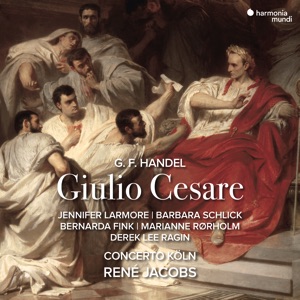
René Jacobs directs Concerto Köln in this 1991 release of Handel’s Giulio Cesare, with a cast including Jennifer Larmore and Barbara Schlick. That date identifies the recording’s release, not the composition of the opera. The linked programme contains forty-five tracks, including an appendix; it is distinct from the separately issued selection of excerpts.
Start with the transition
You need not memorise every character before listening. First notice the difference between passages shaped around speech and those that expand a thought into song. Hear what a short exchange makes you expect, then keep that expectation in mind during the following aria. A pause in outward events need not mean that nothing changes. A phrase can gather pressure, release it, or return with a different weight. Listening across the boundary gives a familiar tune a more specific purpose.
An orchestra inside the scene
Follow the instruments while the singer holds your attention. They may introduce a movement, answer a phrase or leave room around a voice. Choose one of those relationships rather than trying to identify everything at once. When music returns, compare the space and emphasis with its first appearance. Repetition becomes an opportunity to reconsider what has been heard, rather than simply an obstacle on the way to the next event.
A practical route through the set
The length invites several visits. Begin with an instrumental introduction and the aria after it, then widen the frame on another day. Track boundaries are not a list of isolated songs: some entries combine dialogue and several scenes. The appendix follows the dramatic ending and should be heard as a separate addition. Harmonia Mundi’s 2018 three-CD reissue and the digital edition’s four disc groups organise this performance differently. Counting those groups alone cannot establish whether music is missing. For listening, the useful unit is the change from speech to song, and the scene that gives that change its meaning.
The album through its tracks
Begin with the Sinfonia before V’adoro, pupille, keeping the transition into the aria intact.
Giulio Cesare in Egitto, HWV 17, Atto II: Scena 2, V'adoro, pupille
Begin one track earlier, with the Sinfonia, and carry its atmosphere into the vocal entry. The label identifies this as Cleopatra’s aria in Act II. Rather than treating the tune as a self-contained recital number, hear what happens to the instrumental movement after the voice arrives. On a second visit, choose the sounds between vocal phrases and follow who seems to initiate each exchange. The accompaniment becomes an active part of the scene. When familiar music returns, compare your sense of expectation with the opening. You do not need a full plot summary to notice how a singer and an ensemble share the listener’s attention.
Reference · Harmonia Mundi: complete recording, 2018 reissue programmeGiulio Cesare in Egitto, HWV 17, Atto III: Scena 3, E pur cosi - Piangerò
The combined title matters: E pur cosi precedes Piangerò within this track. Listen for the point where speechlike delivery opens into a longer musical span, rather than expecting the aria to begin at the first second. The label places this Cleopatra scene in Act III. Compare its handling of a vocal phrase with V’adoro, pupille: how long is a thought held, and what remains around it when the voice stops? Calling the music sad is only a starting point. Attention to the duration and release of each sentence gives that impression a more precise shape, without requiring the listener to know the opera’s eventual resolution.
Reference · Harmonia Mundi: complete recording, 2018 reissue programme
Listen next
Return to Handel’s Water Music and compare instrumental exchanges with an orchestra supporting a sung scene.
Handel: Water Music & Music for the Royal Fireworks ↗References & editorial note
Written for English readers. Album facts are referenced below; listening suggestions are editorial interpretations. AI-assisted editorial review; not independently human-reviewed.