Folk / Country / Outlaw country & Americana · 1973
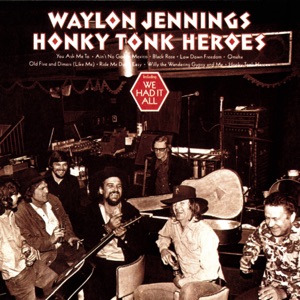
Honky Tonk Heroes
Waylon Jennings
Why listen
Billy Joe Shaver’s writing supplies most of the material, while Jennings turns compact narratives and firm rhythmic movement into an album identity.
Listen and read
Tracks · previews
English editorial edition
Album story
Treating Honky Tonk Heroes only as a portrait of a rebellious singer obscures a central collaboration. Waylon Jennings sings; Billy Joe Shaver wrote or co-wrote nine of the ten songs. Performing someone else’s material does not mean surrendering an identity. Choices about how a phrase starts, moves with the band and reaches its ending help create the character we hear.
Released by RCA in 1973, the album became an important outlaw-country statement. It need not be credited with inventing a movement single-handedly. The Country Music Hall of Fame describes a broader pursuit of creative freedom by several artists. Track credits also name producers beyond Jennings and Tompall Glaser, including Ronny Light and Ken Mansfield. Independence should not erase collaborators or suggest a completely uniform recording process.
Hear propulsion change
Approach the title track by comparing its opening storytelling with the increase in momentum, rather than treating it as a slogan delivered at one intensity. Does the band change with the singer? A rough public image and precise musical decisions are not opposites. Look for the arrangement that makes a transition register, then hear the shorter songs that follow as distinct situations.
Nine songs does not mean nine solo credits
Shaver’s central role still leaves room for collaborators. Hillman Hall shares the writing credit on Omaha, and Jennings on You Ask Me To. There is no need to memorise every name before listening. Simply resist converting every first-person statement into literal autobiography. Ask how pronunciation, rhythm and sequencing make separately written songs seem to belong together.
A different writing partnership closes
We Had It All, by Donnie Fritts and Troy Seals, ends the programme after Black Rose. Its different authorship does not place it outside the album’s character. Compare the feeling left by that ending with the promise of the opening title. The compact programme changes scenes rather than stretching one gesture indefinitely; returning to the beginning may broaden what rebellion means within these particular songs.
The album through its tracks
Follow the title track’s changing momentum, then hear You Ask Me To through the closing transition from Black Rose to We Had It All.
Honky Tonk Heroes
The opening track lasts approximately three minutes and forty-one seconds in this current album edition. It is not a substituted live performance or compilation edit. Compare its initial delivery with the later increase in force: does the change belong only to the singer, or also to the band? Shaver wrote the song, while Jennings contributes singing and production, so an emphatic phrase does not establish a literal event in the singer’s biography. Focus instead on choices that make another person’s writing sound like direct speech. Carry that impression into Old Five and Dimers (Like Me). A large title about heroes need not promise only stories of successful people.
Reference · Qobuz RCA Nashville: ten-song programme, durations and writing/production creditsYou Ask Me To
Choose track six’s approximately two-minute-thirty-five-second album recording. The expanded edition adds a similarly named single version, which should not be merged with it through a title-only match. Shaver and Jennings share the writing here, bringing together the roles of songwriter and singer. Follow the economical placement of short phrases against a recurring pulse. A definite statement need not be a shouted one, and a compact song can still vary the way a line closes or leads into the next. Continue into Ride Me Down Easy to hear how this request gives way to another scene. Its brevity makes a second listen useful rather than making its detail unimportant.
Reference · Qobuz RCA Nashville: ten-song programme, durations and writing/production credits
Listen next
Continue with Gram Parsons’s Grievous Angel to compare how country writing and vocal performance form a different character through another combination of musicians.
Grievous Angel ↗References & editorial note
Written for English readers. Album facts are referenced below; listening suggestions are editorial interpretations. AI-assisted editorial review; not independently human-reviewed.
- Legacy Recordings: album programme and two later bonus tracks · www.legacyrecordings.com
- Country Music Hall of Fame: Outlaws exhibition guide, Billy Joe Shaver biography · cmhof.imgix.net
- Qobuz RCA Nashville: ten-song programme, durations and writing/production credits · www.qobuz.com
- Apple Music: selected Sony ten-song distribution · music.apple.com
- Spotify: same Sony ten-song programme and durations · open.spotify.com