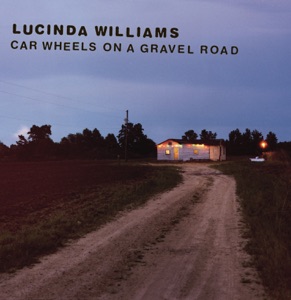
Folk / Country / Outlaw country & Americana · 1998
Car Wheels on a Gravel Road
Lucinda Williams
Why listen
Songs named for places meet carefully chosen band arrangements, making remembered movement tangible across thirteen distinct performances.
Listen and read
Tracks · previews
English editorial edition
Album story
Roads and place names run through Car Wheels on a Gravel Road, but it is not simply a guide to touring the South. A location can recall a person; movement can raise the question of what has been left behind. Rather than enlarging the title song into one landscape covering the entire album, compare how each performance advances or holds its ground. Specific names do not make all thirteen songs episodes of the same event.
The original 1998 programme begins with Right In Time and ends with Jackson. Williams writes most of the material, but the authorship is not entirely solitary: Can’t Let Go and Still I Long for Your Kiss have distinct writing credits. Nor do guitars, keyboards and percussion merely decorate a literary text. Accompaniment changes the apparent speed of a phrase and the weight a sentence carries.
Start from details
The title song’s child-centered perspective makes the road more complicated than an emblem of adventure. Preserve its concrete setting, then move into 2 Kool 2 Be 4-Gotten rather than making one song explain everything. Even without recognizing every reference, a listener can follow how a melody and its accompaniment carry a sentence. Details leave room for connections instead of resolving every meaning in advance.
Apparent immediacy can be constructed
The recording engineers’ recollections describe basic performances followed by overdubs and decisions about which combinations belonged together. Liveliness therefore should not be equated with an untouched single take. Metal Firecracker offers a particularly useful example of preserving a working relationship between parts. Listen to the resulting arrangement instead of allowing a reputation for perfectionism to replace the music.
Continue after Joy
Greenville and Still I Long for Your Kiss lead toward Joy, but Jackson still follows. Keep that final place name in the programme. A sequence can bring separate songs into proximity without turning them into a continuous diary by one fixed character. Alternate between the narrative details and the band’s movement to hear how the record organizes its density.
The album through its tracks
Begin with the title song’s specific scenes, hear the relationships within Metal Firecracker, and continue beyond Joy to Jackson.
Car Wheels On a Gravel Road
The second track lasts approximately 4:45. Williams’s account of its child-centered viewpoint makes the road more complex than a simple symbol of enjoyable travel. Rather than turning the song into a checklist of biographical facts, hear how the returning title gathers the surrounding details. Compare the continuing movement of the accompaniment with the shape of the sung phrases. Strong writing does not always require a large declaration of emotion; recurring particulars can leave listeners to connect what lies between them. Approach from Right In Time and continue into the third track, preserving this song as one entrance among several into the album. The original studio performance is selected here.
Reference · NPR interview via WJCT: Williams describes title-song perspectiveMetal Firecracker
The ninth track lasts approximately 3:31. Ray Kennedy recalled retaining an earlier mix because Gurf Morlix’s supporting vocal mattered to its character. That account directs attention toward a relationship between parts, rather than assuming that more elaborate production always requires adding something. Hear how the lead performance, accompanying singing and instrumental movement fit together. Calling the result merely rough can obscure such choices. Place it between I Lost It and Greenville and compare how the three performances organize their energy. This is the original album’s ninth studio recording, not the live version included separately in the deluxe edition. The production story offers a listening question, not proof that every sound was captured in one untouched take.
Reference · Mix: Ray Kennedy and Jim Scott describe recording, overdubs and Metal Firecracker mix
Listen next
Continue to Wrecking Ball and compare Emmylou Harris’s setting of Williams material with the decisions Williams makes when shaping her own programme.
Wrecking Ball ↗References & editorial note
Written for English readers. Album facts are referenced below; listening suggestions are editorial interpretations. AI-assisted editorial review; not independently human-reviewed.
- UMG Sound of Vinyl: original thirteen-title programme · thesoundofvinyl.com
- Qobuz / Mercury: original album versions, writers and durations · www.qobuz.com
- Mix: Ray Kennedy and Jim Scott describe recording, overdubs and Metal Firecracker mix · www.mixonline.com
- NPR interview via WJCT: Williams describes title-song perspective · news.wjct.org
- Apple Music: thirteen-track Mercury original programme · music.apple.com