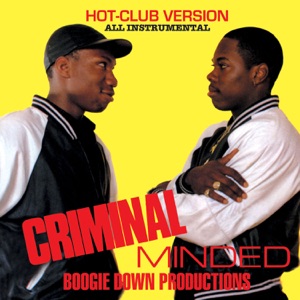
Hip-hop / Golden-age New York · 1987
Criminal Minded
Boogie Down Productions
Why listen
Hear how a voice can keep changing the shape of a beat that barely moves.
Listen and read
Tracks · previews
English editorial edition
Album story
Start with the space around KRS-One. On “Poetry,” the backing gives his consonants somewhere to land; its repetition makes a change of emphasis feel like an event. Criminal Minded does not require a crowded arrangement to sound forceful. The voice supplies much of the movement, shifting between declaration, ridicule and a more melodic way of carrying a phrase.
Released by B-Boy Records in 1987, Boogie Down Productions’ album puts KRS-One and DJ Scott La Rock at its centre. Across ten tracks, demonstrations of verbal skill share room with territorial challenges and disturbing narratives. Those modes are related, but they are not interchangeable. Listen for who is being addressed, and for the difference between a rapper announcing himself and a narrator constructing a scene.
An arrangement made of emphasis
A useful first pass is to keep time with the drums while letting the words travel independently. A held vowel can pull against that steady pulse; a clipped ending can reinforce it. Repeated names and places also give the listener a point of return. You need not understand every reference to hear the alternating stretches of detailed speech and compact, memorable address.
Connections across the water
The Jamaican connection deserves more precision than calling the record vaguely reggae flavoured. Wayne Marshall’s 2006 dissertation connects “Remix For P Is Free” with the Mad Mad rhythmic family. That later research opens a route through the album without reducing every vocal gesture to a sample identification. A borrowed recording and a way of delivering words are different things; both can carry musical memory.
A record that permits disagreement
Robert Christgau’s assessment values the musical imagination while objecting to aspects of the sexual and violent language and the territorial argument. Respect for the record need not erase that tension. An NME review is indexed for July 1987, but its inaccessible text cannot establish a contemporary consensus here. The edition linked is the ten-track programme, not the separately listed Deluxe or Hot-Club-Version. Let the title track close that sequence before exploring extra material: its position matters to the experience of a compact album.
The album through its tracks
Keep time with the drums, then follow only the changes in vocal emphasis.
Poetry
The opener makes verbal placement the main attraction. Rather than waiting for a large melodic refrain, notice how a phrase claims the foreground, then leaves a little room before the next one arrives. Keep a steady pulse with your hand and follow the ends of sentences. They do not all feel equally weighted, even when the backing returns to familiar ground. On a second pass, follow the pauses inside the delivery instead. A brief gap can make the next word seem to strike harder. Remember this comparatively direct opening when the album moves toward more sing-song phrasing: the change is a different use of the voice as rhythm.
Reference · Apple Music: original ten-track digital programmeRemix For P Is Free
The word “Remix” can be misleading in an album menu: this is track seven of the original ten-track programme, not a bonus appended decades later. Marshall’s study places its backing in a Jamaican rhythmic lineage, a useful invitation to follow the repeated figure beneath the vocal. First mark where that figure returns, then notice whether the delivery cuts across it or stretches a sound over it. The rhythmic attraction does not neutralise the sexual and drug-related subject matter. Keeping those responses separate makes the listening more revealing. You can recognise the movement of a musical idea while remaining uncomfortable with the scene built around it.
Reference · Wayne Marshall: Routes, Rap, Reggae (2006), chapter seven
Listen next
Compare Paid in Full from the same year: Rakim and KRS-One organise the space around a repeating beat in markedly different ways.
Paid in Full ↗References & editorial note
Written for English readers. Album facts are referenced below; listening suggestions are editorial interpretations. AI-assisted editorial review; not independently human-reviewed.
- Apple Music: original ten-track digital programme · music.apple.com
- Robert Christgau: Consumer Guide assessment · www.robertchristgau.com
- Wayne Marshall: Routes, Rap, Reggae (2006), chapter seven · wayneandwax.com
- Rock’s Backpages: John McCready, NME review bibliography, 11 July 1987 · www.rocksbackpages.com