Jazz / Cool & West Coast · 1959
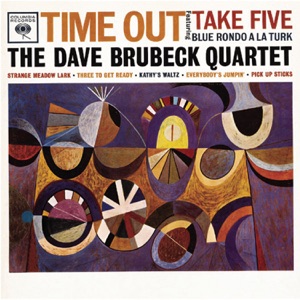
Time Out
The Dave Brubeck Quartet
Why listen
An unfamiliar metre becomes a place for four players to move differently together.
Listen and read
Tracks · previews
English editorial edition
Album story
There is no need to begin Time Out by counting. Follow a clipped piano figure, a longer alto line or the weight of a drum accent. The Dave Brubeck Quartet makes an unusual rhythmic frame feel tangible through the contrast between the people playing inside it.
Recorded in New York in 1959 and released by Columbia that year, the album features Brubeck on piano, Paul Desmond on alto saxophone, Eugene Wright on bass and Joe Morello on drums. The seven-track digital edition follows the original programme documented by the Brubeck Collection. Desmond, rather than Brubeck, composed Take Five. Anniversary bonus performances and the later Time Outtakes collection should remain distinct from these album versions.
A pattern before a number
On a first listen, locate the point where a short shape comes back. That can be enough to establish a foothold without knowing the time signature. Listen for what a melodic line does while piano or bass preserves a repeating reference. Does the same pattern seem to change weight when another player enters? Counting can eventually help describe the experience, but it need not become a test that must be passed before the music can be enjoyed.
Seven different openings
The transition from Blue Rondo À la Turk to Strange Meadow Lark offers an immediate contrast between concentrated motion and a wider breath. Take Five then supplies a familiar landmark, but the record continues through four more pieces. Compare the beginnings of Three to Get Ready, Kathy’s Waltz and Pick Up Sticks. Instead of treating the famous single’s rhythm as an explanation of the entire album, let each piece establish its own way of returning to a pattern.
Hear behind the solo
When one instrument takes the foreground, the others still help define the space. Shift attention from the most obvious line to the bass and hear whether the balance changes. Anyone who knows this music as an agreeable background can use a short passage twice, choosing the least noticeable part on the second pass. The exercise brings the quartet’s work into focus before the album’s historical reputation takes over. Memorable melody and rhythmic experimentation meet through these relationships, not through a time signature printed on a page.
The album through its tracks
Return to a familiar melody while following the bass or drums beneath it.
Blue Rondo À la Turk
Compare the tightly grouped opening figures with the looser movement that follows. Brubeck’s first track is a useful doorway into contrasting kinds of motion, rather than a lesson that must be solved. Its opening nine-unit pattern is mainly grouped as two, two, two and three, with variations in the grouping. The selected recording lasts about six minutes and forty-nine seconds. Instead of counting throughout, notice what happens to your sense of tension when the clipped theme returns. Follow the piano on one pass and the saxophone entry on another. Recognising a returning shape and remembering how the music opened out beforehand provides a practical experience of form without requiring specialist terminology.
Reference · Stephen A. Crist: Time Out, Library of Congress commissioned essayTake Five
If the alto melody is familiar, begin underneath it with the repeating piano and bass pattern. The five-beat frame supplies a recurring point of reference even before its notation is understood. Paul Desmond composed the piece; this selection is the third track’s album performance, lasting about five minutes and twenty-nine seconds, rather than a short single edit or a concert version. When the drums move to the foreground, keep listening for the accompaniment that remains. A featured solo does not necessarily mean everybody else stops. Turn attention back to the tune when it returns, and ask whether the intervening drum movement has changed the apparent weight of that familiar line.
Reference · Stephen A. Crist: Time Out, Library of Congress commissioned essay
Listen next
Chet Baker Sings offers a different balance between a foreground melody and the rhythmic space supporting it.
Chet Baker Sings ↗References & editorial note
Written for English readers. Album facts are referenced below; listening suggestions are editorial interpretations. AI-assisted editorial review; not independently human-reviewed.
- The Brubeck Collection: Time Out, Columbia CS8192, programme and personnel · www.brubeckcollection.org
- Dave Brubeck estate: Time Out repertoire and Take Five composer · www.davebrubeck.com
- Stephen A. Crist: Time Out, Library of Congress commissioned essay · www.loc.gov
- Apple Music: seven-track Time Out · music.apple.com