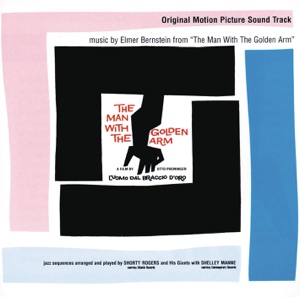
Film music / Jazz in film scores · 1955
The Man with the Golden Arm
Elmer Bernstein
The Man with the Golden Arm · 엘머 번스타인
Why listen
Brass and drums make jazz a source of dramatic pressure, not merely a stylish setting.
Listen and read
Tracks · previews
English editorial edition
Album story
The sharp outlines of the brass and the insistence of the drums give this score an immediate physical presence. Listen beyond that initial impact, though: quieter passages alter the meaning of the forceful ones. Bernstein can make musical energy feel like pressure on a character rather than simple confidence or celebration.
Otto Preminger’s 1955 film stars Frank Sinatra as Frankie, who hopes to become a drummer. The original soundtrack album followed in 1956. This listening link preserves its eleven-track programme in a Geffen digital edition carrying a 2013 copyright notice; that is not a date for a new performance. Nor is the album a Sinatra vocal set. Its musical organisation serves a dramatic world even when heard without the film.
Jazz players inside a composed drama
The French national library’s soundtrack catalogue credits Shorty Rogers’s jazz arrangements and performances, with Shelly Manne on drums. Their presence does not turn the whole score into an open improvising session. The music is shaped around dramatic purposes: an emphatic rhythm can propel action while also making us feel the character’s unease. Try following what remains after the loudest instruments withdraw, rather than measuring tension by volume alone.
More than eleven separate scenes
The opening Clark Street track groups The Top, Homecoming and Antek’s. Similar compound titles elsewhere remind us that an album track can contain several musical cues. Character titles such as Zosh and Molly sit alongside an action title like Audition. Heard on record, those different jobs become contrasts of pace, weight and melodic space. You need not reconstruct every scene to hear the programme changing its point of view.
A breakthrough without a false first
The score received an Academy Award nomination in 1956, not a win. In a 2001 interview, Bernstein also acknowledged earlier composers’ use of jazz, describing this score instead as unusually dominated by jazz elements. That retrospective distinction is more useful than calling it the first jazz film score. In the same interview he stressed that film music exists to serve a film. Listening through the softer passages, rather than repeatedly isolating the famous theme, preserves something of that dramatic responsibility.
The album through its tracks
Hear the transitions within the opening track, then compare Audition at track nine with the quieter character music.
Clark Street: The Top / Homecoming / Antek's
The compound title is a useful listening instruction: this track groups several cues rather than promising one unchanging piece. Follow the shift away from its forceful opening and notice how the next section changes pace or density. On a first pass, simply mark the larger boundaries. On a second, listen for what connects them, whether a rhythmic impulse or a melodic trace. Without a screen, those transitions still establish movement between public space and a character’s situation. This is the opening of the original soundtrack programme, not a later band’s standalone theme cover. The familiar musical gesture gains meaning from what follows it.
Reference · Elmer Bernstein official discography:1956eleven-track soundtrackAudition
For a character hoping to work as a drummer, an audition carries more weight than a chance to display technique. Follow the percussion first, then widen your attention to the surrounding ensemble. Shelly Manne’s participation belongs to the recording credits; Sinatra’s presence on screen does not make this a record of the actor performing every instrumental part. Try resisting the assumption that an energetic passage automatically signals triumph. The concentration of sound and the spaces around it can also convey pressure. Comparing this track with the character pieces earlier in the album makes the different dramatic tasks of the instrumental writing easier to hear.
Reference · BnF catalogue: Shorty Rogers and Shelly Manne soundtrack credits
Listen next
Leonard Bernstein’s On the Waterfront provides a contemporary contrast in musical approaches to urban and personal pressure.
On the Waterfront ↗References & editorial note
Written for English readers. Album facts are referenced below; listening suggestions are editorial interpretations. AI-assisted editorial review; not independently human-reviewed.
- Elmer Bernstein official discography:1956eleven-track soundtrack · elmerbernstein.com
- Apple Music:original soundtrack, Geffen digital edition · music.apple.com
- Elmer Bernstein interview, ASCAP Playback July–August2001 · elmerbernstein.com
- BnF catalogue: Shorty Rogers and Shelly Manne soundtrack credits · catalogue.bnf.fr
- Academy:1956score nomination · www.oscars.org
- Cash Box March10,1956:main-title single review · www.worldradiohistory.com