Film music / European auteur cinema · 1962
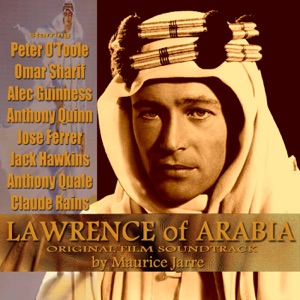
Lawrence of Arabia
Maurice Jarre
Lawrence of Arabia · 모리스 자르
Why listen
Broad melodic space and sharply defined percussion make this compact soundtrack more varied than its famous theme suggests.
Listen and read
Tracks · previews
English editorial edition
Album story
The melody can seem to open an immense horizon, but listen beside it. Percussive attacks and restless passages keep the music from becoming a continuous scenic postcard. Maurice Jarre gives the orchestra both breadth and a sense of immediate action, even when the pictures are absent.
This is the original soundtrack programme associated with David Lean’s 1962 film. The Science Museum’s Colpix/Pye LP record credits Jarre as composer and conductor and the London Philharmonic Orchestra as performers; it dates that British issue to 1963. Film year, regional album release and later digital edition should remain separate. The original twelve-track programme is a selection, not every cue heard across the long film.
An album with several kinds of motion
Overture and Main Title offer differently proportioned entrances. Miracle and Nefud Mirage move attention between melodic breadth and more unsettled textures. Rescue of Gasim and Bringing Gasim into Camp joins two named episodes within one track. You need not reconstruct every scene to follow the alternation of sustained lines and urgent movement. The march character of Kenneth Alford’s The Voice of the Guns introduces another kind of regularity into the programme.
Recognition at different dates
Jarre received the 1963 Academy Award for substantially original music score. That establishes early institutional recognition, rather than a unanimous response from audiences. Much later, AFI placed the score third in its film-music selection. Neither distinction replaces the experience of hearing how a returning theme changes against its surroundings. Attend to the instruments carrying the rhythm as well as those carrying the tune.
Know which performance you are hearing
The linked 2013 digital edition follows the original twelve-track sequence. Other editions split the joined Gasim cue, while subsequent recordings present new performances; Tadlow announced a complete-score recording project in 2010. More tracks do not necessarily mean an extension of this original recording. Finally, the desert heard here is a cinematic construction. The orchestral language should not be treated as a documentary survey of the music of an entire region.
The album through its tracks
Separate the long melodic line from the shorter percussive gestures in Overture, then compare Main Title.
Overture
Instead of following only the familiar melody, divide your attention between the sustained orchestral line and the attacks that give it an edge. They create different sensations of distance: one seems to stretch the horizon while the other marks a position within it. Loud playback is not essential to noticing that contrast. On a second hearing, listen beneath the tune for sounds that enter briefly and disappear. The opening then becomes a changing arrangement rather than a single grand statement. Continue directly into Main Title and compare their proportions. Both introduce the same musical world, but they need not make their impression in the same way.
Reference · Apple Music US: twelve-track 2013 digital remasterRescue of Gasim and Bringing Gasim into Camp
The original album joins these two named episodes in one track. That continuity is useful: listen for a change of pressure within the music rather than treating each title as an isolated scene description. Notice how busy the accompaniment becomes beneath a forward-moving line, and where the weight of the sound begins to shift. You do not need plot details, or an exact timestamp for the division, to follow a change of breath. On another pass, concentrate on a repeated figure underneath the most prominent instrument. This longer span offers a different listening scale from the short title music surrounding it on the album.
Reference · Both Sides Now: Colpix CP/SCP-514 original twelve-track programme
Listen next
Continue with Duke Ellington’s Anatomy of a Murder to hear a jazz orchestra build cinematic tension through concise instrumental exchanges.
Anatomy of a Murder ↗References & editorial note
Written for English readers. Album facts are referenced below; listening suggestions are editorial interpretations. AI-assisted editorial review; not independently human-reviewed.
- Science Museum Group: original Colpix/Pye LP, Jarre and London Philharmonic Orchestra · collection.sciencemuseumgroup.org.uk
- Both Sides Now: Colpix CP/SCP-514 original twelve-track programme · bsnpubs.com
- Apple Music US: twelve-track 2013 digital remaster · music.apple.com
- Academy: 1963 original score award · www.oscars.org
- AFI: 100 Years of Film Scores · www.afi.com
- Tadlow: Winter 2010 newsletter, new complete-score recording planned · www.tadlowmusic.com
- Schott Music: Kenneth Joseph Alford catalogue, The Voice of the Guns · www.schott-music.com