Pop / Foundations of pop songwriting · 1964
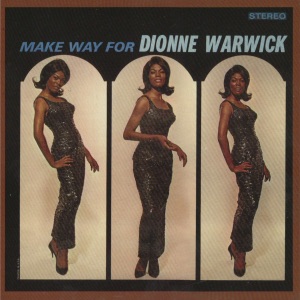
Make Way for Dionne Warwick
Dionne Warwick
Why listen
The feeling need not arrive as a vocal explosion. Warwick makes a phrase worth following, while the accompaniment remains active around its pauses.
Listen and read
Tracks · previews
English editorial edition
Album story
Listen to the end of a phrase in Walk On By rather than waiting for its highest note. Warwick can hold your attention by the way she continues a thought, not just by increasing its volume. The accompaniment has something to do when she rests, too. That exchange is a useful entrance to Make Way for Dionne Warwick: a record whose apparent ease leaves room for small changes in pressure, distance and breath.
Released by Scepter in 1964, this was Warwick’s third album, produced by Burt Bacharach and Hal David. Their names matter, but concentrating only on the songwriters can obscure the singer who makes an intricate line feel conversational. Begin by following the voice across contrasting songs. You do not need to identify every compositional detail to notice how a more insistent delivery changes the space around a quieter one.
Restraint is not an absence of feeling
A controlled voice need not represent a settled mind. Follow the length of a phrase, or the moment it gives way to the instruments. On a second pass, turn your attention to those gaps instead of the tune you already remember. A familiar song can become a conversation between different parts of the arrangement rather than a vocal performance with decoration behind it.
Let the less familiar titles stay
If a hit brought you here, try keeping its neighbours in the listening sequence. A change of pace can alter how a known song reaches you. Ask where Warwick sounds as if she is speaking directly to someone, and where she seems to keep a little distance. Those shifts offer a reason to hear an album beyond a list of famous performances.
Know which edition is playing
The twelve-track digital reference labels its opening selection French & English. It should not be presented as proof that every take matches the first LP. Its 2004 rights notice also differs from the album’s 1964 release. Such distinctions can help comparison without turning listening into homework. If a preview catches your attention, continue to the full song and follow how its ending changes your memory of the beginning.
The album through its tracks
Compare the measured distance of Walk On By with the more outward address of Reach Out for Me. The digital reference labels its opening track French & English.
Walk On By
Wait for the space after a sung phrase. The feeling does not have to grow louder at every return for the next line to matter. In a 2014 Recording Academy recollection, Warwick described recording with the orchestra as a performance-like experience. Treat that as a later memory, not a contemporary session transcript. It nevertheless offers a listening question: what do the instruments carry while the singer rests? The single’s Hall of Fame induction came in 1998, distinct from its 1964 release. Set the honour aside and compare successive returns of a familiar phrase. Does restraint create distance, or make you listen more closely? Recognition can lead to attention rather than end it.
Reference · Dionne Warwick: The Making of Walk On By, Recording Academy, 2014 recollectionReach Out for Me
Move here after Walk On By and compare the direction of the address. The invitation in the title points outward, but the words alone do not explain the effect. Follow where the voice and accompaniment seem to gather momentum together, and what continues when the singer leaves space. Rhino’s retrospective identifies this as one of the album’s successful singles; that is not a substitute for a specific contemporary chart position or a survey of listeners. Your own comparison can be immediate: how does the same singer make encouragement feel different from emotional distance? Listen once to the accompaniment, then return to the voice. Force need not be measured only by volume.
Reference · Rhino: Make Way for Dionne Warwick, retrospective album note
Listen next
Continue with Dusty Springfield’s Dusty in Memphis and compare how a singer places emotional closeness within the movement of an arrangement.
Dusty in Memphis ↗References & editorial note
Written for English readers. Album facts are referenced below; listening suggestions are editorial interpretations. AI-assisted editorial review; not independently human-reviewed.
- Rhino: Make Way for Dionne Warwick, retrospective album note · www.rhino.com
- Dionne Warwick: The Making of Walk On By, Recording Academy, 2014 recollection · www.grammy.com
- Recording Academy: GRAMMY Hall of Fame · www.grammy.com
- Apple Music: Make Way for Dionne Warwick, current twelve-track edition · music.apple.com