Rock / British Invasion & 1960s pop rock · 1968
The Beatles
The Beatles
Why listen
A double album makes abrupt differences of scale and style part of the listening experience.
Listen and read
Tracks · previews
English editorial edition
Album story
A loud band suddenly gives way to a guitar and a close voice. A comic miniature interrupts; near the end, fragments of sound yield to a lullaby. The Beatles is compelling partly because its songs refuse to travel in one direction. Each doorway can change the size of the room you thought you were in.
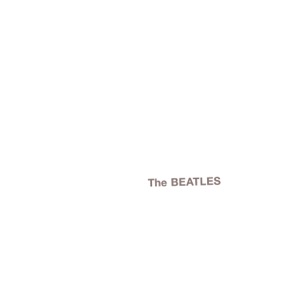
The double LP appeared on 22 November 1968 and became known as the White Album after its sleeve. Much of the songwriting began during the group’s stay in India, followed by acoustic demos at George Harrison’s Esher home. Studio work ran from late May into the autumn. Although recording could be dispersed, the official 2018 account also stresses group performances used as basic takes. Four unrelated solo records is therefore an inadequate description.
Hear the neighbours
Instead of searching for one story across thirty tracks, attend to their meeting points. Back In the U.S.S.R. gives way to the repeating guitar of Dear Prudence, changing the sense of space almost immediately. A miniature can alter the remembered proportions of a longer song. You need not like every track equally to explore what its neighbours make possible.
Four manageable sections
Use the original LP sides as stopping points if the length feels daunting. They end with Happiness Is a Warm Gun, Julia, Long, Long, Long and Good Night. That final lullaby follows the sound collage of Revolution 9. Neither texture cancels the other. At each pause, recall the voice that felt closest and the sound that seemed farthest away; the contrast offers a route through the variety.
Different packages, different claims
The album reached number one in Britain and America, which establishes commercial reception rather than agreement about every song. Official session histories are later accounts. The linked 2009-labelled digital package contains thirty audio tracks plus a separate video: thirty-one listed items do not mean thirty-one original songs. The 2018 remix by Giles Martin and Sam Okell, with expanded demos and sessions, is a different edition. Listen beyond predictions of the eventual breakup to the coexistence of shared playing and intimate individual voices.
The album through its tracks
Try the original four LP sides as listening units, attending to how each ending reframes what came before.
Dear Prudence
The repeating guitar seems to remain in place while the sounds around it enlarge the room. Keep that initial pattern in mind instead of waiting only for a climax. Notice how voice and rhythm gather around it: repetition becomes a way of accommodating change. The official song page identifies John Lennon as the writer while retaining the Lennon–McCartney credit, a useful distinction that need not turn listening into biography. Hear the track directly after Back In the U.S.S.R. as well. Its entrance acquires a different character following that energetic opening. Near the end, compare the density with the beginning and consider how much the apparently steady pattern has allowed to happen.
Reference · The Beatles: Dear Prudence official song pageBlackbird
A close voice fits between the guitar’s small movements. The reduced scale can feel like a retreat from the surrounding arrangements, but it need not be heard as an empty resting place. Follow how the guitar creates intervals of space and how a sung phrase occupies them. The official page identifies Paul McCartney as the writer under the shared Lennon–McCartney credit. Rather than fix the bird image to one historical interpretation here, begin with the relationship between sounds. On one pass, follow the sustained vocal notes; on another, attend to the guitar continuing beneath them. Fewer instruments do not necessarily mean fewer changes in emotional movement, especially in this second-side setting.
Reference · The Beatles: Blackbird official song page
Listen next
The Beatles’ Revolver (1966) provides a contrast between concentrated variety on one LP and the wider spaces of this double album.
Revolver ↗References & editorial note
Written for English readers. Album facts are referenced below; listening suggestions are editorial interpretations. AI-assisted editorial review; not independently human-reviewed.
- The Beatles: original album and release history · www.thebeatles.com
- Apple Corps2018: recording account · www.thebeatles.com
- Apple Corps:2018remix and expandedprogramme distinction · www.thebeatles.com
- The Beatles: Dear Prudence official song page · www.thebeatles.com
- The Beatles: Blackbird official song page · www.thebeatles.com
- Apple Music:selected2009digitalpackage · music.apple.com