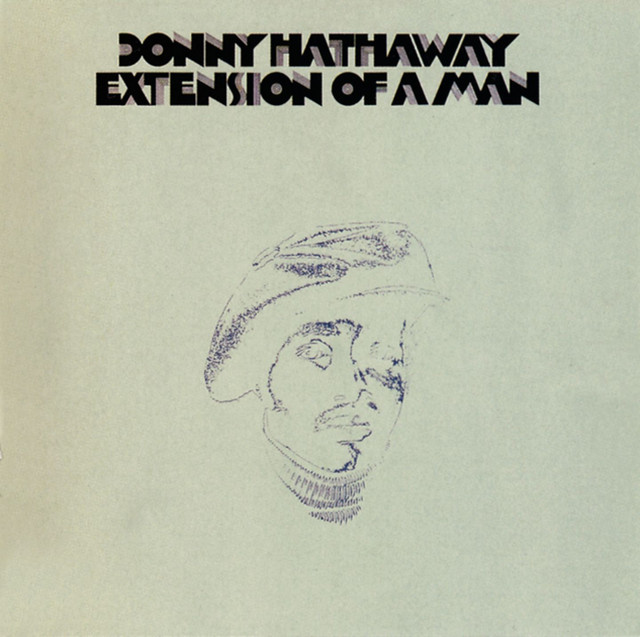
Soul / R&B / Singer-songwriter soul · 1973
Extension of a Man
Donny Hathaway
Why listen
A singer, keyboard player and arranger reveals different dimensions of his work through a deliberately varied programme.
Listen and read
Tracks · previews
English editorial edition
Album story
Extension of a Man does not introduce its singer with an immediately recognisable vocal performance. It opens on a larger orchestral scale, allowing the familiar voice to enter in the second track. The listener encounters an arranger before settling into the role of hearing a singer.
Hathaway’s keyboards, writing and arrangements make the variety coherent without forcing every song into an identical setting. Arif Mardin’s production accommodates large ensembles and smaller rhythm sections. The opening piece and Valdez in the Country therefore offer markedly different views of the same musician. One builds a broad frame; the other brings keyboard movement and rhythmic conversation close to the listener.
An entrance before the voice
I Love the Lord, He Heard My Cry combines two parts in one opening track. Someday We’ll All Be Free then relocates the centre of attention to a vocal melody. The voice arrives within a musical world that has already been established. Mardin later recalled Hathaway’s capacity for both funk and symphonic writing. That observation provides context for the contrast rather than an account of every decision made during these sessions.
Keyboards at different scales
Flying Easy leads into Valdez in the Country, where the keyboard and rhythm section become the main attraction. I Love You More Than You’ll Ever Know, written by Al Kooper, follows with an extended vocal performance and tenor saxophone. The first five tracks do not simply shrink from orchestra to band. Their changing proportions keep redefining the keyboard’s role, from accompaniment to a more prominent instrumental voice.
Finding the original ending
The later sequence moves through Come Little Children, Love, Love, Love and The Slums before the shorter Magdalena. I Know It’s You, written by Leon Ware, closes the original album. That endpoint matters: the programme includes other writers without losing Hathaway’s shaping presence. Lord Help Me follows only as a bonus in this edition. Hearing the original conclusion before that addition makes the album’s architecture clearer. Its vitality lies in these musical choices, which deserve attention without being reduced to a retrospective account of the singer’s life.
The album through its tracks
Follow the orchestral opening into Someday We’ll All Be Free, then compare that entrance with the keyboard-led Valdez in the Country.
Someday We’ll All Be Free
The second track moves from the scale of the orchestral opening toward the clarity of a vocal line. Hathaway and Edward Howard share the writing credit, with Howard’s lyrics also identified by the label. That division is useful context without becoming a complete explanation of the singer’s private feelings. Follow the distinct lines around the voice: keyboard, trumpet and rhythm instruments give the melody a setting that remains articulated rather than blurred. This selection uses the approximately four-minute-eleven-second album performance. Its placement between the opening piece and Flying Easy matters as much as its familiar refrain. Hear it within that sequence, separate from another singer’s interpretation or an extended concert rendition.
Reference · Qobuz / Rhino Atlantic: eleven-track LP versions, times and personnelValdez in the Country
The fourth track brings Hathaway’s electric piano and the rhythm section into focus. Cornell Dupree and Keith Loving contribute guitars, with Willie Weeks on bass, Ray Lucas on drums and Ralph MacDonald on percussion. Their smaller ensemble offers a different perspective from the orchestral opening. Across approximately three minutes thirty-one seconds, follow the keyboard’s motion against the pulse and the different spaces occupied by guitar and percussion. This is an instrumental scene with its own purpose, not merely an interval between vocal performances. Its position between Flying Easy and the longer I Love You More Than You’ll Ever Know makes the contrast especially clear. The selected link retains the full album track rather than substituting a live version.
Reference · Qobuz / Rhino Atlantic: eleven-track LP versions, times and personnel
Listen next
Continue to Bill Withers’s Just As I Am to compare this varied instrumental palette with a more compact setting for the singer.
Just As I Am ↗References & editorial note
Written for English readers. Album facts are referenced below; listening suggestions are editorial interpretations. AI-assisted editorial review; not independently human-reviewed.
- Warner Music Japan: original programme plus explicit bonus · wmg.jp
- Qobuz / Rhino Atlantic: eleven-track LP versions, times and personnel · www.qobuz.com
- Wax Poetics: Arif Mardin interviewed, original2003 feature · magazine.waxpoetics.com
- Rhino: original ten-song programme and separate Quadio edition · store.rhino.com