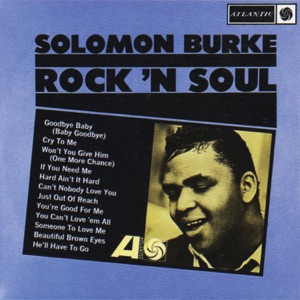
Soul / R&B / From rhythm and blues to soul · 1964
Rock 'n Soul
Solomon Burke
Why listen
A compact introduction to soul as a way of addressing a listener, across country ballads and rhythm-and-blues singles.
Listen and read
Tracks · previews
English editorial edition
Album story
Solomon Burke can sound as though he is speaking to one person and gathering a room around him at the same time. Rock ’n Soul gives that ability several settings. Its unity comes from the singer’s changing manner of persuasion, rather than from a single mood or a continuous story.
Released by Atlantic in 1964, the record draws together work from the preceding years. Treat it as a portrait assembled from singles, not as a session conceived and recorded all at once. The changes of pace become part of its interest: a buoyant rhythm can carry loneliness, while a measured ballad can make a quiet request feel increasingly urgent.
Songs travel between audiences
The programme includes “He’ll Have to Go,” associated with Jim Reeves, and “Hard, Ain’t It Hard,” associated with Woody Guthrie. These choices make genre boundaries sound permeable. Burke does not need to erase a melody’s earlier associations to inhabit it. Follow the weight he gives a word, then the space he leaves before the next phrase. The voice supplies a particular speaker even when the song has already travelled through other musical worlds.
Success before the retrospective
There is a useful distinction between contemporary reception and later reputation here. Rhino’s retrospective identifies seven selections that entered the US Hot 100. Those are singles results, not an album chart position, and they establish that this music reached listeners before later histories organised it into a story about soul. Rhino’s 2019 album feature describes the set as something like a collection of early highlights. That description is a later assessment, not a newly uncovered review from 1964.
Choose the programme carefully
The twelve-track mono edition used here opens with “Goodbye Baby.” Another digital edition begins with “Cry to Me” and changes the sequence. Rhino presented the mono release in November 2014; the original album belongs to 1964. Listening straight through this edition lets the final “He’ll Have to Go” draw the attention inward after the more outward-moving songs. On a second pass, compare how the accompaniment keeps its footing while Burke alters the emotional pressure. That relationship is more revealing than simply counting the loudest or highest notes.
The album through its tracks
Keep the accompaniment’s pulse in mind, then notice how Burke stretches a sentence without making the whole song hurry.
Cry To Me (Mono)
Start with the recurring pulse rather than the famous vocal. The rhythm keeps moving while Burke makes the invitation increasingly personal, alternating compact phrases with longer appeals. That gives the song its productive tension: loneliness is the subject, but isolation is not the experience offered to the listener. A first hearing may draw attention to vocal power. On the next, notice how the backing remains steady instead of copying every emotional rise. The singer can lean against that stability. Its contemporary US pop-chart appearance is useful context, but the musical invitation remains small enough to feel addressed to someone standing nearby, rather than to an abstract audience.
Reference · Rhino: Mono Mondays, 10 November 2014He'll Have To Go (Mono)
A song familiar through Jim Reeves closes this programme by reducing the apparent distance between singer and listener. Attend to the end of a sustained note and the interval before the next request. Burke can make the waiting matter as much as the words. The melody retains its smooth outline while the speaker’s need becomes harder to dismiss. Calling this simply a country song transformed into soul would overlook what survives the journey: its intimate scale and conversational premise. Compare it with “Cry to Me.” There, a regular movement invites someone out of loneliness; here, the performance asks the listener to stay close and hear the uncertainty inside an apparently composed voice.
Reference · Rhino: Mono Mondays, 10 November 2014
Listen next
Continue with Sam Cooke’s Ain’t That Good News for another 1964 balance of melodic ease and emotional insistence.
Ain't That Good News ↗References & editorial note
Written for English readers. Album facts are referenced below; listening suggestions are editorial interpretations. AI-assisted editorial review; not independently human-reviewed.