Blues / Prewar Delta & country blues · 1996
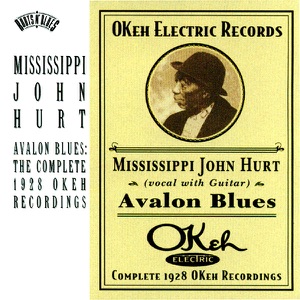
Avalon Blues: The Complete 1928 Okeh Recordings
Mississippi John Hurt
Why listen
A quietly delivered voice moves through changing stories while the guitar sustains several kinds of motion at once.
Listen and read
Tracks · previews
English editorial edition
Album story
Mississippi John Hurt’s guitar can be busy without making his singing hurry. Follow the returning low notes and the brighter figures between them: the fascination lies in how easily one performer seems to accommodate both activities.
Avalon Blues is a later collection of recordings made for Okeh in 1928, not an album conceived as a continuous programme that year. Beneath the historical recording surface is an exact relationship between words, pulse and space, rather than a vague ideal of rustic simplicity.
Two dates, different meanings
Hurt recorded in Memphis and New York in 1928. The linked thirteen-track digital edition carries a 1996 date, which belongs to the collection rather than the performances. Its running order need not be read as a long narrative planned by the singer. From Frankie to Spike Driver Blues, approach each song as a small independent stage. The instrumentation stays spare, but the breathing of the vocal and the openings in the guitar change. A returning bass note gives you a stable point from which to hear those differences.
More than one kind of song
Narrative songs, blues and religious material coexist here. The tragic subject of Louis Collins meets a restrained delivery; that contrast can be heard as an invitation to absorb the story without being told how dramatically to react. Later, Blessed Be the Name and Praying On the Old Camp Ground redirect the same voice towards different purposes. Set aside the expectation that blues must always announce itself through a harsh attack or a cry. Repetition and the space at a phrase ending can carry their own intensity.
A later audience
The place named in Avalon Blues helped Tom Hoskins locate Hurt in 1963. The Library of Congress account of the resulting field recordings stresses that his abilities remained intact. This later encounter does not establish the scale of his commercial success or critical reception in 1928. Nor does a gap in recording mean music vanished from his local life. Learn the relationship between voice and guitar here before comparing his later recordings: the useful differences will be in particular phrases, not an automatic opposition between youth and age.
The album through its tracks
Follow the returning bass notes first, then the higher guitar figures around the ends of the vocal phrases.
Avalon Blues
Treat the returning low guitar notes as a walking pace, then listen to the higher figures and voice moving around them. The hometown named in the song later helped a listener locate its performer, but the recording need not become a prophecy of that encounter. The song and its subsequent history occupy different moments. On a second pass, set the famous anecdote aside and attend to what the guitar continues after a vocal phrase ends. A consistent pulse need not feel stationary when small figures keep altering its surface. You do not need to name a picking technique to hear the contrast between an unhurried delivery and accompaniment that keeps moving.
Reference · Library of Congress: Tom Hoskins collection and 1963 recordingsLouis Collins
A tragic narrative is carried with a gentleness that may initially seem surprising. Waiting for the singer to become overtly distressed can obscure the continuing guitar movement and the slight distance his delivery creates. The Hurt Foundation identifies this as a murder ballad; the recording alone cannot establish every detail of a real event. Listen instead to the stance of someone retelling a story. Follow the steady instrumental floor first, then the interval between one sentence and the next. Bright movement in the accompaniment does not make the subject trivial. Restraint can leave listeners room to register sorrow without a conspicuous musical instruction to feel it.
Reference · Mississippi John Hurt Foundation: musical background and Louis Collins
Listen next
Compare Robert Johnson’s King of the Delta Blues Singers for another relationship between solo guitar, voice and musical time.
King of the Delta Blues Singers ↗References & editorial note
Written for English readers. Album facts are referenced below; listening suggestions are editorial interpretations. AI-assisted editorial review; not independently human-reviewed.
- Apple Music: Avalon Blues, 13-song digital programme and 1996 date · music.apple.com
- Library of Congress: Tom Hoskins collection and 1963 recordings · blogs.loc.gov
- Mississippi John Hurt Foundation: musical background and Louis Collins · www.msjohnhurtfoundation.org
- National Park Service: 1928 Memphis and New York sessions · www.nps.gov
- Mississippi Blues Trail: local performance and later folk circuit · msbluestrail.org