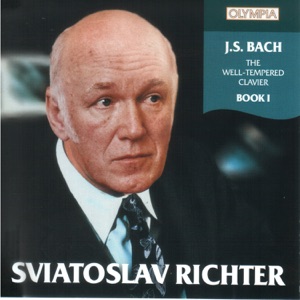
Classical / Baroque · 1970–73
Bach: The Well-Tempered Clavier
Sviatoslav Richter
바흐: 평균율 클라비어곡집 · 스비아토슬라프 리히테르
Why listen
A single piano opens into several moving lines, making attentive listening more rewarding than simply completing the cycle.
Listen and read
Tracks · previews
English editorial edition
Album story
The opening prelude offers a continuous pattern; the fugue that follows seems to admit several speakers into the same room. Richter’s Well-Tempered Clavier becomes approachable when you choose one line rather than try to account for every note. Follow the continuity of the sound, then the separate paths moving within it. Those are different kinds of attention.
Bach’s two books each contain twenty-four pairs of preludes and fugues, covering the major and minor keys. The complete collection therefore comprises forty-eight pairs, separated into ninety-six tracks in this edition. Richter plays a modern piano in studio recordings made in 1970 for Book I and in 1972–73 for Book II. The sessions belong to a different historical moment from the composition, and from the later digital release linked here.
A manageable unit
A prelude can establish a pattern or gesture; the following fugue lets a short theme enter through different melodic lines. These independent lines are called voices, even on a keyboard. If you always treat the highest notes as the melody, you can miss an entry lower down. Shift your attention when the theme returns. One pair is a satisfying listening unit; the next key offers another atmosphere within the same instrument.
A title with an open question
Well-tempered should not automatically be equated with the evenly spaced semitones of modern equal temperament. Scholars disagree about the tuning Bach intended. You need not resolve that question before hearing the collection’s passage through the keys. Nor must Richter’s piano impersonate an earlier keyboard instrument: listen to how lingering notes and independent lines coexist within this particular interpretation.
Return instead of rushing
The linked Musical Concepts reissue appeared in 2014 and is distinct from Richter’s complete Innsbruck concert cycle of 1973. Its roughly four and a half hours need not be heard at once. Try the first pair, then return to it while following the lower line. Familiar music can reveal another route when your attention changes. That repeated encounter matters more than treating the final track as a finishing line.
The album through its tracks
Recognise the fugue’s opening theme, then follow its return at another pitch level.
Book I: Prelude No. 1 in C Major, BWV 846
A regular broken-chord pattern carries a changing sequence of harmonies. This prelude begins Book I; its companion fugue shares the BWV number but occupies a separate track. Follow the upward flow first, then attend to how a change in the lower notes alters the colour of the whole. Similar movement does not mean an unchanged harmony. In Richter’s performance, consider the sound that remains behind each new note as well as the attack itself. Stay through the final pause and continue into the fugue. The shift from a continuous pattern towards interacting lines makes the pair’s contrast audible, beyond the pleasure of recognising a familiar opening.
Reference · Alto ALC4003 official booklet: works, track order and 1970/1972/1973 sessionsBook II: Fugue No. 9 in E Major, BWV 878
Remembering the short opening theme gives you a place to return to within the longer span. This is the fugue from Book II’s ninth pair, separately indexed from its prelude. Hear them together if possible, noticing the change in their manner of movement. Instead of following only the highest notes, move your attention when the theme appears at another level. An earlier line continues while a new one enters, so the piano gradually becomes a meeting of paths rather than a single block of harmony. There is no need to count every entrance. If you lose the thread, begin again at the next statement you recognise.
Reference · Alto ALC4003 official booklet: works, track order and 1970/1972/1973 sessions
Listen next
Compare Gould’s 1955 Goldberg Variations for another pianist’s organisation of a different Bach keyboard work.
Bach: Goldberg Variations 1955 ↗References & editorial note
Written for English readers. Album facts are referenced below; listening suggestions are editorial interpretations. AI-assisted editorial review; not independently human-reviewed.
- Alto ALC4003 official booklet: works, track order and 1970/1972/1973 sessions · media.musicalconcepts.net
- Apple Music: Richter, Musical Concepts 2014 complete 96-track edition · music.apple.com
- Mark Lindley, Staatliches Institut für Musikforschung: well-tempered tuning and scholarly disagreement · www.simpk.de
- Parnassus: separate 1973 Innsbruck live cycle and dates · www.parnassusrecords.com