Classical / Classical era · 1988–1989
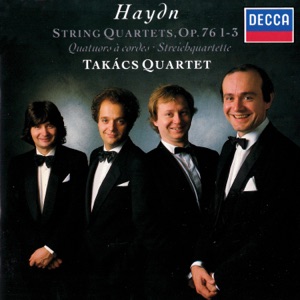
Haydn: String Quartets Op. 76
Takács Quartet
하이든: 현악4중주 Op. 76 · 타카치 콰르텟
Why listen
Four players can redirect a conversation without adding another voice.
Listen and read
Tracks · previews
English editorial edition
Album story
Try listening below the highest melody. A repeated figure, a brief reply from the middle or a shared pause may reveal more about the relationship between the players than a memorable tune alone. The Takács Quartet’s Haydn Op.76 offers six opportunities to shift that attention while keeping the scale of the ensemble intimate.
The linked2004 compilation contains all six quartets in twenty-four movements. It gathers earlier performances: the Decca session catalogue places Nos.1–3 in Vienna in August1987 and Nos.4–6 in London in September1988, with original issues in1988 and1989. The players are Gábor Takács-Nagy, Károly Schranz, Gábor Ormai and András Fejér. This is the earlier membership, not a1996 session by a later version of the ensemble.
Move the centre of attention
Two violins, viola and cello do not always retain fixed jobs. Begin with the line that is easiest to follow, then choose a smaller movement beneath it on a second visit. Listen for the moment another instrument takes over the sentence. When everyone becomes emphatic together, can a separate voice still be followed? Identifying each instrument correctly is less useful at first than noticing how attention changes the shape of a passage.
Six works, not one long quartet
Op.76 is a group of six works, each with four movements. Give one complete quartet a sitting before moving through the whole collection. The proportion of slower music, dance and closing activity becomes easier to remember that way. Familiar names such as Emperor and Sunrise offer entrances, but they need not determine the whole experience. The unnamed fifth and sixth quartets also allow you to choose your own centre of gravity.
Listen around the firmness
After a strong joint gesture, notice the space that remains. Forward motion can depend on a brief withdrawal as much as on an accent. Rather than fixing this performance with one adjective, compare the beginnings and endings of phrases. The compilation date does not indicate new players or new sessions. Knowing which ensemble is present lets a returning melody become an encounter with these four musicians, while leaving the listener free to discover different routes through their exchanges.
The album through its tracks
Alternate between melody and surrounding voices in the Emperor slow movement and the opening of Sunrise.
Op.76 No.3 — II. Poco adagio, cantabile
The memorable melody in the Emperor quartet can attract nearly all the attention. Try keeping its shape in mind while following the voices around it instead. Familiarity in one line can coexist with movement and tension elsewhere. You need not identify every instrument to sense that one voice stays close to home while another takes a different route. This is the second movement of the third quartet, located at disc one, track ten, not a separate piece that stands for the entire collection. Continue into the following minuet to experience the change from sustained song to a dance. The interest lies as much in the relationships supporting the tune as in recognising it.
Reference · CHARM Decca Vienna discography:1987 sessions and1988 issueOp.76 No.4 — I. Allegro con spirito
Sunrise need not prescribe a picture. First notice the distance between a supporting texture and the line moving above it. As the music becomes more active, remember that opening relationship and hear how much of it remains. Follow the upper line on one pass and the movement underneath on another; the same opening may suggest an expanding scene or the moment four people begin to speak. This is disc two, track one, or the thirteenth movement in the complete sequence. Let the following Adagio continue the experience rather than deciding the character of the fourth quartet from its opening alone. A nickname is an invitation to listen, not a substitute for the work.
Reference · CHARM Decca British discography:1988 sessions and1989 issue
Listen next
Try Brüggen’s London Symphonies for orchestral exchanges on a larger scale, then return to these four string voices.
Haydn: London Symphonies ↗References & editorial note
Written for English readers. Album facts are referenced below; listening suggestions are editorial interpretations. AI-assisted editorial review; not independently human-reviewed.
- Gábor Takács-Nagy official discography: both Op76 volumes · www.gabortakacsnagy.com
- CHARM Decca Vienna discography:1987 sessions and1988 issue · charm.kcl.ac.uk
- CHARM Decca British discography:1988 sessions and1989 issue · charm.rhul.ac.uk
- Apple Music: complete24movements,2004 compilation · music.apple.com