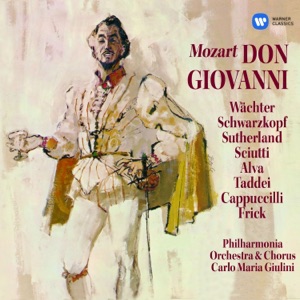
Classical / Classical era · 1959
Mozart: Don Giovanni
Carlo Maria Giulini / Philharmonia
모차르트: 돈 조반니 · 카를로 마리아 줄리니 / 필하모니아
Why listen
Solo statements and ensembles reveal competing interests around the title character in Giulini’s 1959 studio recording.
Listen and read
Tracks · previews
English editorial edition
Album story
Remembering Don Giovanni only as an opera about one charismatic villain can obscure the music of everyone forced to deal with him. Leporello serves and complains; Elvira responds through both attachment and betrayal. Their interests do not coincide. Begin with the servant’s catalogue aria and the statue’s arrival rather than the protagonist’s solo display. One scene describes his conduct through another person; the other brings a response to that conduct.
Giulini recorded the Philharmonia Orchestra and Chorus at Abbey Road in October and November 1959. Eberhard Wächter sings Giovanni, Giuseppe Taddei Leporello and Gottlob Frick the Commendatore. Joan Sutherland’s Anna and Elisabeth Schwarzkopf’s Elvira represent distinct positions. This selection uses the seventy-four opera indexes from the 2025 remaster, omitting the appended Rossini Tancredi overture. The large number of entries reflects divisions of dialogue and musical numbers, not seventy-four independent compositions.
Who owns the catalogue?
Taddei’s servant describes his employer’s behaviour to Elvira rather than boasting about his own affairs. Knowing the relationship directs attention beyond verbal agility to the transfer of information. Comic presentation need not erase the women reduced to entries in the list. The manner of a servant making a report and the harm disclosed by that report can be considered together.
Different purposes in shared music
An aria concentrates a person’s feeling or claim; an ensemble brings people with different purposes into simultaneous activity. Anna and Elvira are not interchangeable because both have high voices. Knowledge and misunderstanding redirect their words. Treating orchestra and conductor as more than a backdrop for celebrated singers also makes the transitions between individual statements and collective encounters part of the drama.
What follows the confrontation
The statue’s visit gives earlier evasion a different weight. Frick and Wächter represent an encounter, not a contest over low notes. The opera continues afterwards with the survivors’ epilogue. The protagonist’s disappearance and the work’s ending are not identical events. Listening through that difference restores a place for characters whose existence exceeds their relationship to the man named in the title.
The album through its tracks
Distinguish speaker and listener in Taddei’s catalogue aria, then follow the statue scene through to the later epilogue.
Madamina, il catalogo è questo
Leporello’s catalogue aria is sung here by Taddei. Recognising its title without identifying the speaker can make it sound like the protagonist’s own boast. Instead, the servant explains his master’s conduct to Elvira. When enumeration generates comedy, consider what this information means to its recipient. Verbal speed or clear delivery alone cannot describe the relationship: one person manages a record that another must confront. There is no need to memorise the numbers or treat them as a score of achievement. Compare the later statue scene, where the servant who described another man’s behaviour stands beside its consequences. That connection allows the humour to remain part of the drama without becoming an automatic excuse.
Reference · Metropolitan Opera: dramatic situations and the catalogue sceneDon Giovanni, a cenar teco
The Commendatore’s statue arrives at dinner, with Frick, Wächter and Taddei occupying different roles. Rather than ranking three voices by depth or force, distinguish the visitor, the protagonist confronting him and the servant nearby. A shared space does not mean an identical experience. Leporello, previously explaining his master’s conduct in the catalogue aria, now occupies the encounter himself. This index belongs to an extended finale and is not the opera’s last item. Further events and the survivors’ epilogue follow. Hearing this confrontation alone therefore does not exhaust the ending. Separating the dramatic centre from the actual closing point makes room for the other characters beyond the title figure and the immediate force of the supernatural scene.
Reference · Metropolitan Opera: dramatic situations and the catalogue scene
Listen next
After comparing soloists and chorus in Böhm’s Requiem, consider how operatic characters pursue different purposes within shared music here.
Mozart: Requiem ↗References & editorial note
Written for English readers. Album facts are referenced below; listening suggestions are editorial interpretations. AI-assisted editorial review; not independently human-reviewed.
- Warner Classics: 1959 studio sessions and complete cast · www.warnerclassics.com
- Warner Classics: 2025 remastered issue and official streaming link · www.warnerclassics.com
- Warner Classics: complete remastered edition, CDs 38–39 track table · www.warnerclassics.com
- Metropolitan Opera: dramatic situations and the catalogue scene · www.metopera.org
- Apple Music: official-linked 2025 distribution · music.apple.com