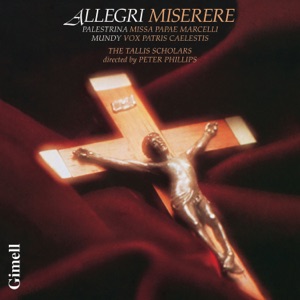
Classical / Medieval & Renaissance · 1980
Palestrina: Missa Papae Marcelli
The Tallis Scholars
팔레스트리나: 교황 마르첼리 미사 · 탈리스 스콜라스
Why listen
Follow one voice until another takes up its movement. The choir becomes a meeting of individual lines rather than a single beautiful surface.
Listen and read
Tracks · previews
English editorial edition
Album story
Choose one voice at the start of the Kyrie and follow it for as long as you can. When another enters, does your first line continue underneath? Losing it is not a failure: pick up a new thread. The pleasure here need not depend on a spectacular high note. It can arrive when several moving sentences briefly seem to face the same direction.
This selection refers to Peter Phillips and the Tallis Scholars in 1980. The linked remaster preserves that recording, not their later return to the same repertoire. It also includes works by Allegri and Mundy. Its forty-six digital tracks are indexed sections, not forty-six separate compositions. Palestrina’s Mass begins at track twenty-one; knowing that prevents a search for this work from turning into a confusing tour of the entire programme.
Try the lower line
On a second visit, follow a lower voice instead of the brightest one. Notice whether it holds its ground while the upper lines move, and whether the singers pause together. An unaccompanied choir need not sound empty. Equally, you need not find it automatically relaxing. If resonance makes the words difficult to follow, try a quieter volume and one movement at a time. Listening is not an examination in identifying every part.
A story does not have to become a legend
The Mass is often attached to a tale in which Palestrina saved elaborate church music from prohibition. Phillips’s notes themselves caution against accepting that account as secure history. Set it aside and compare the short pleas of the Kyrie with the longer verbal flow of the Gloria. This gives the relationship between words and music something concrete to mean, without requiring a lesson in ecclesiastical politics before pressing play.
A recording, not an abstract masterpiece
Gimell identifies this as its first recording and reports a number-one placing in the UK HMV classical chart. That is a particular market achievement, not proof of universal approval. Today, try attending to the space around the voices. Let the sound after a phrase count as part of it. Then return to the final Agnus Dei. You can meet this album through the Mass alone; finishing every coupled work is not an obligation.
The album through its tracks
Start at track twenty-one, or compare the opening Kyrie section with the final Agnus Dei. A preview cannot show the complete accumulation and release of voices.
Missa Papae Marcelli: 1a. Kyrie eleison I
Find the first line you notice and listen for what happens when another arrives. Does the earlier movement continue behind it? The short plea for mercy at the start of the Mass invites a different pace from a long narrative sentence. There is no need to hear it as evidence for the legend that this composition rescued church music from prohibition; Phillips’s own notes question that story. Instead, notice how much movement a few words can support. This digital edition splits the Kyrie into three sections. Continue into the Christe and returning Kyrie before judging the movement’s shape. The first preview represents an opening, not the whole musical argument.
Reference · Gimell CDGIM639: recording, remaster and Peter Phillips notesMissa Papae Marcelli: 5b. Agnus Dei II
Try following a line that answers another rather than the voice that sounds brightest. Phillips describes a change of vocal disposition and an imitative structure in this final section. You do not need the technical name to notice a similar movement reappearing at a different height. Compare it with Agnus Dei I immediately beforehand: a quiet conclusion can still change its balance. Remember that this is the closing Mass section of the selected 1980 performance, not an interchangeable example of every recording by these singers. It may suggest repose or continued pleading. Let the final resonance diminish before deciding which impression stays with you, rather than demanding an uplifting response.
Reference · Gimell CDGIM639: recording, remaster and Peter Phillips notes
Listen next
Continue with Tallis’s Spem in alium. Compare how the encounters between lines change when the vocal design becomes much larger.
Tallis: Spem in Alium ↗References & editorial note
Written for English readers. Album facts are referenced below; listening suggestions are editorial interpretations. AI-assisted editorial review; not independently human-reviewed.