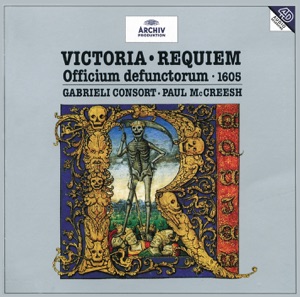
Classical / Medieval & Renaissance · 1995
Victoria: Officium Defunctorum
Gabrieli Consort
빅토리아: 성무일도 · 가브리엘리 콘소트
Why listen
Listen for the change between interwoven voices and a single melodic line. The quieter links help the choral passages acquire their scale.
Listen and read
Tracks · previews
English editorial edition
Album story
Choose one voice in the Kyrie and follow it until another entrance attracts your attention. You do not need to translate every Latin syllable. When the programme returns to a simpler melodic line, the density of the preceding chorus becomes easier to remember. The attraction here is not uninterrupted richness: the sequence lets a small sound matter beside a larger one. Two short sections can provide an entrance into an unfamiliar tradition.
The linked Gabrieli and Paul McCreesh programme belongs to the 1995 Deutsche Grammophon release, rather than the archive’s existing 1987 label. Neither date describes Victoria’s lifetime. Its nineteen tracks divide a ritual sequence, not nineteen unrelated concert pieces. Short prayers and recitations are part of the listening experience. Keeping them in place changes how you encounter the more immediately attractive choral writing, even if the religious setting is unfamiliar.
Let a single line be enough
If several voices make the music difficult to follow, stay with the clearest one. Missing another part is not a mistake. Ask only whether the singers seem to travel together or take different routes. You can hear that distinction without increasing the volume. Brief utterances alternating with longer singing also create a pace across the programme that is different from the speed of any individual movement.
A response close to its release
Writing in The Independent in January 1996, Edward Seckerson treated this performance as an attempt to recover the experience of a ceremony. That is one critic’s reading near the release, not a survey of its audience. Gabrieli’s official history also identifies reconstructions of historical events as a characteristic activity. This context makes the smaller links worth considering rather than treating them as obstacles between favourite choruses.
No prescribed emotional response
Music for the dead need not require you to summon a particular private grief. You may find the blended voices comforting or unsettling. Begin with Kyrie and Sanctus, then add the passages beside whichever interests you. There is no obligation to finish the whole programme in one sitting. Returning later to the difference between a solitary line and overlapping voices is already a meaningful way of making the recording your own.
The album through its tracks
Begin with track3 Kyrie and track12 Sanctus, then keep their neighbours in the sequence.
Kyrie
Follow the voice you notice first. When another enters, see whether your attention stays with the original line or moves elsewhere. This petition belongs within a ritual sequence rather than functioning only as a detached concert miniature. Seckerson’s January 1996 review emphasised the contrast between plainchant and overlapping choral voices across the recording. Use that as a possible listening question, not a required emotional response. Continue into the short prayer that follows: a simpler texture can make the preceding richness clearer. Accurate Latin pronunciation is not a listening test. Locating where a voice begins and ends gives you something concrete to revisit on a second hearing.
Reference · Edward Seckerson, The Independent, January1996 reviewSanctus
Keep the preceding Prefatio attached to this track before deciding how large the choral sound feels. Seckerson’s 1996 response singled out the force of the accumulating voices here. That describes a critic’s reaction, not a command to hear grandeur every time. At a comfortable volume, compare the highest sound you notice with the lowest. Continue into Benedictus so that the section remains part of a sequence rather than an isolated climax. A preview may not convey that transition; the linked external service offers a longer route. You can enjoy the change in scale without identifying every voice or adopting the religious beliefs behind the words.
Reference · Edward Seckerson, The Independent, January1996 review
Listen next
Continue with Palestrina’s Missa Papae Marcelli and compare how the voices gather a phrase.
Palestrina: Missa Papae Marcelli ↗References & editorial note
Written for English readers. Album facts are referenced below; listening suggestions are editorial interpretations. AI-assisted editorial review; not independently human-reviewed.