Hip-hop / West Coast & G-funk · 1995
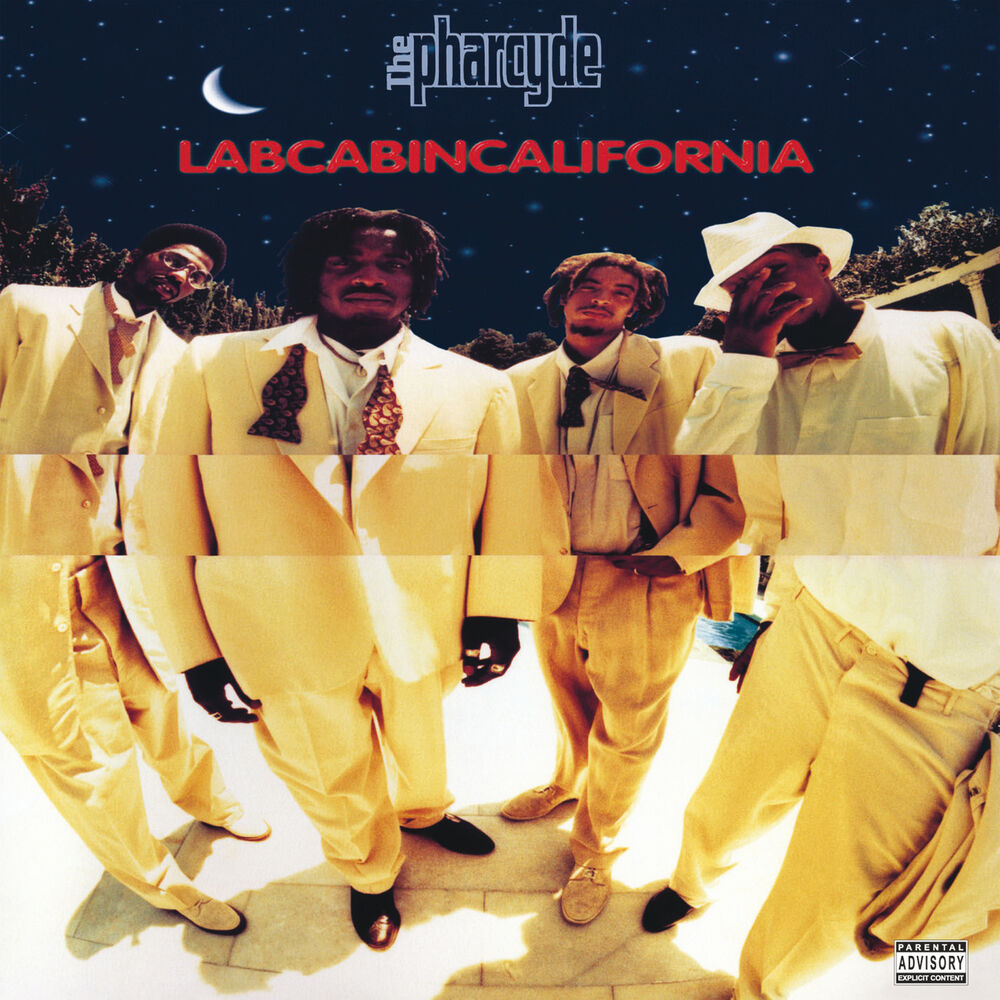
Labcabincalifornia
The Pharcyde
Why listen
Longer rap tracks alternate with brief connecting pieces, placing two familiar singles within an uneven seventeen-track journey.
Listen and read
Tracks · previews
English editorial edition
Album story
It is easy to remember Labcabincalifornia as the home of Runnin’ and Drop. Yet several pieces separate those singles, and considerable music follows them. Notice the mixture of short scenes and fully extended tracks rather than imagining a uniform row of songs. A brief item can change the perceived scale of the next one. Knowing an album’s celebrated singles and knowing its progression offer different kinds of familiarity.
The Pharcyde released their second album on November 14, 1995. Jay Dee, also known as J Dilla, is important to its production history, but his name need not stand in for every contribution by the group. He produced Drop, also associated with Spike Jonze’s reverse-motion video. Here the arrangement can be considered without a screen. The selection preserves the original seventeen tracks, excluding the separate instrumental and remix discs attached to an anniversary edition.
The size of a connecting piece
All Live, at track eight, lasts under a minute in this distribution; Drop immediately afterwards exceeds five. This is more than a numerical contrast. A small unit before an extended track can affect how much space the latter seems to occupy. It’s All Good!, at twelve, is another sub-minute item. The sequence does not treat every entry as a single of identical scale.
Producer and performers together
An important producer’s early work provides an inviting entry, but treating the rapping as an accessory to the beat misses a relationship. Repeated backing can acquire a different character through the length and emphasis of speech. Consider the framework and the group’s movement within it separately, then reunite them. Identifying every sample is not a prerequisite for encountering that interaction.
Beyond the signature song
Drop is ninth, not last. Devil Music and The E.N.D. remain near the eventual close. For someone who remembers the album through its singles, that remaining span may alter its proportions. Return afterwards to the fourth-track Runnin’ and hear a familiar song occupying one location in a larger design. Listening for a favourite and listening for its neighbours can coexist without one cancelling the other.
The album through its tracks
Compare the sub-minute All Live with the extended Drop immediately following it, then continue through the remaining programme.
Runnin'
The single occupies the fourth position among seventeen tracks. If it is already familiar, briefly set aside its independent hit status and notice its place between Groupie Therapy and She Said. A memorable song does not turn everything around it into an appendix. Consider how recurring backing and ongoing rapping share time: the same musical frame can acquire changing emphasis through the placement of speech. Neither identifying the sample source nor memorising a producer’s career is required. Notice what feels familiar when it returns and how the rapping continues across it. After pairing this with Drop, restore the songs between them; their separation within the album becomes part of the comparison.
Reference · Concord: original release date and anniversary expansionDrop
Dilla’s production arrives ninth, after the brief All Live. Spike Jonze’s video is famous for reverse movement, but its visual ingenuity need not explain every aspect of the music. Without a screen, consider recurring backing and the progression generated by rapping within a longer span. The preceding miniature makes this track’s scale especially useful to compare. Extension does not demand entirely new material at every moment; different speech against a returning foundation can also produce development. Hearing Drop is not the same as reaching the album’s conclusion. Eight tracks still follow, with The E.N.D. closing the original programme. Treat this signature song as an expanded central location rather than an automatic final statement.
Reference · Craft Recordings: complete original track order and Drop production
Listen next
Compare the sequence centred on one rapper in Me Against the World with the different pacing of group tracks and shorter connecting pieces here.
Me Against the World ↗References & editorial note
Written for English readers. Album facts are referenced below; listening suggestions are editorial interpretations. AI-assisted editorial review; not independently human-reviewed.
- Craft Recordings: complete original track order and Drop production · craftrecordings.com
- Concord: original programme separated from instrumental and remix discs · mediakits.concord.com
- Concord: original release date and anniversary expansion · mediakits.concord.com
- Apple Music: seventeen-track studio distribution · music.apple.com