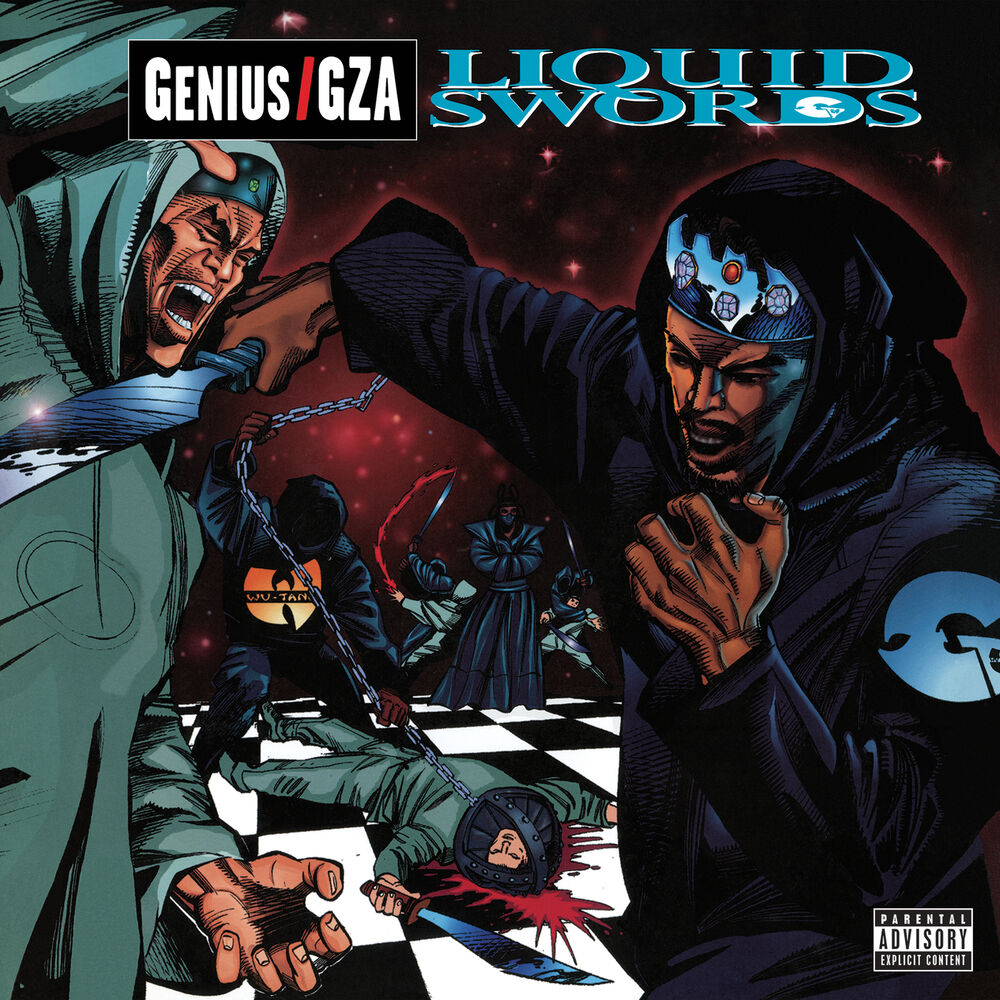
Hip-hop / Hardcore & Wu-Tang · 1995
Liquid Swords
GZA
Why listen
A focused solo record uses changing guest formations, spoken inserts and a deliberately different final track to vary its scale.
Listen and read
Tracks · previews
English editorial edition
Album story
A solo album need not be a continuous monologue. On Liquid Swords, the crowded formation of 4th Chamber gives way to the more concentrated partnership of Shadowboxin’. GZA remains the point of reference, but the people around him alter the dimensions of each track. Their entrances make his return meaningful. Rather than counting famous guests, follow how the arrangement changes when another rapper takes responsibility for the next stretch.
The 1995 album is presented here in its thirteen-track programme, ending with B.I.B.L.E. RZA produces the first twelve tracks; 4th Disciple produces the closing Killah Priest performance. That exception matters to the shape of the record. The title track establishes the named artist at the entrance, while the ending allows somebody else a whole song rather than a brief supporting turn.
A thread, not a screenplay
The spoken material from Shogun Assassin provides a recurring connection. GZA described it as a thread rather than a single governing theme. There is no need to assign every track a corresponding film scene. The transition from dialogue to beat is itself a musical event: speech that sets a scene gives way to speech that also organises time.
Density without constant acceleration
Compare the compact Labels with the longer Cold World. Running time is one difference, but sentence construction offers another. A recurring accompaniment makes the placement of beginnings and endings unusually visible. You can follow that organisation before resolving every allusion. The appeal does not depend on treating the album as a puzzle with a complete answer sheet, or on mistaking a restrained delivery for an absence of pressure.
A separate closing statement
After I Gotcha Back, B.I.B.L.E. changes both rapper and producer. It works differently from the rapid changes of personnel in a collective track. One guest receives an entire concluding space. Returning from that ending to 4th Chamber reveals two ways a solo record can accommodate collaborators: by exchanging turns inside a performance, and by allowing a distinct performance to stand alongside the artist’s own.
The album through its tracks
Follow the changes of rapper in 4th Chamber, then compare the guest roles in Shadowboxin’ and the closing B.I.B.L.E.
Liquid Swords
The title track makes the transition from sampled speech to rapping part of its opening design. Notice how the arrival of the beat changes the job performed by the words. GZA recalled that the hook drew on a routine shared with his collaborators years earlier. Its return gives the verses a recognisable point of reference without requiring every line to be delivered in the same shape. This selection is the regular vocal album version, not the instrumental on a later expanded release. Continue into Duel of the Iron Mic to hear the opening statement acquire a larger cast, rather than isolating the title song as a complete summary of the record.
Reference · Wax Poetics — GZA explains the recording, track by track4th Chamber
RZA, Ghostface Killah and Killah Priest join GZA on the seventh track. The recurring accompaniment provides a stable comparison surface for different deliveries: notice how each rapper handles the end of a phrase and the entrance into the next one. Treat a change of performer as a new paragraph rather than waiting for a large sung chorus to divide the performance. Shadowboxin’, which follows with Method Man, makes a useful second comparison because its personnel are less crowded. The selected recording is the regular album vocal take. It is distinct from the instrumental version and from the combined video presentation of the two neighbouring tracks.
Reference · Qobuz / Geffen — original thirteen-track programme and production credits
Listen next
Return to Enter the Wu-Tang (36 Chambers) to compare a collective album’s many centres with their rearrangement around GZA on this solo record.
Enter the Wu-Tang (36 Chambers) ↗References & editorial note
Written for English readers. Album facts are referenced below; listening suggestions are editorial interpretations. AI-assisted editorial review; not independently human-reviewed.
- Wax Poetics — GZA explains the recording, track by track · magazine.waxpoetics.com
- Qobuz / Geffen — original thirteen-track programme and production credits · www.qobuz.com
- Qobuz / Geffen — current expanded delivery, vocal programme first thirteen tracks · www.qobuz.com
- Universal Music Japan — 1995 CD MVCG-186 · www.universal-music.co.jp
- Apple Music — current thirteen-track Liquid Swords · music.apple.com