Jazz / Cool & West Coast · 1957
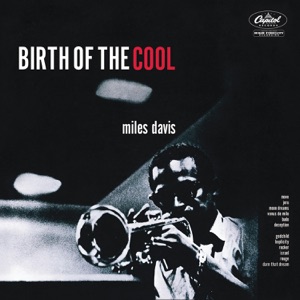
Birth of the Cool
Miles Davis
Why listen
Nine instruments blend into a shared voice without losing the small movements inside the ensemble.
Listen and read
Tracks · previews
English editorial edition
Album story
The attraction of Birth of the Cool is not confined to Miles Davis’s trumpet. Listen to the group sound: high and low instruments can merge into one shape, then reveal lines moving independently inside it. A compact performance can contain several changes of focus without needing an extended solo.
The album gathers recordings made by Davis’s nonet in 1949 and 1950 into an eleven-track LP released in 1957. Those are different moments in the music’s history. Its nine-piece instrumentation includes French horn and tuba alongside more familiar jazz-combo forces, offering a range of colours between the small group and the big band.
Short pieces, active exchanges
Move and Jeru establish the opening before Moon Dreams changes the density and pace of attention. Later, Boplicity, Rocker and Israel lead toward Rouge. There is room for improvisational interest within these brief forms: an ensemble passage can prepare an individual statement, and the return to the group can change how that statement is remembered. Try hearing the same track twice, first following the most prominent melody and then listening beneath it. The arrangement becomes an activity rather than a fixed frame.
A collective arrangement
Davis led the project, but the ensemble’s identity also depends on collaborators including Gil Evans, Gerry Mulligan and John Lewis. It would be misleading to describe the sound as one person’s invention. Several horns need not play a melody in unison simply because they enter together. Follow a lower line and notice how it alters the outline of the group. An instrument can contribute to the texture without remaining a passive foundation beneath the lead.
Do not let the title dictate the tempo
Cool need not mean slow, emotionally vacant or rhythmically weak. A measured blend of instruments can coexist with energetic motion. Instead of learning a historical slogan before listening, ask which part occupies the foreground and when that changes. The music need not be understood as a single event that severed jazz from its past. It is also a meeting place for ideas about ensemble scale, instrumental colour and solo space. Those relationships reward repeated listening long after the title has become familiar. The eleven-track programme provides a concise route through them.
The album through its tracks
Hear the blended horn sound first, then follow a lower part and the transitions into individual statements.
Move
The opener is a useful check against equating cool with a slow tempo. The ensemble establishes a compact shape while creating room for individual movement. Rather than following only the most prominent instrument, listen beneath it for parts taking a different route through the beat. Remember a passage played by the group, then return to hear how your attention shifts toward a solo voice. The interest is not simply that one person starts when everyone else stops; the foreground itself changes. Playing this short track twice can turn an initial impression of speed into an appreciation of placement. Energy and detailed arrangement are available together from the beginning.
Reference · MilesDavis official:1957LP, recordingperiod and11tracksMoon Dreams
Alternate between following a single melody and hearing the combined colour of the ensemble. You do not have to name every instrument to notice that the lower parts can change the meaning of a line above them. On one pass, stay with that upper line; on another, ask whether the surrounding sound holds still or moves elsewhere. A smooth surface need not make every harmonic turn feel settled. Listen for tension remaining between one sonority and the next. Set beside Move, the piece shows how the same scale of ensemble can encourage a different sense of time without making the internal motion any less important.
Reference · MilesDavis official:1957LP, recordingperiod and11tracks
Listen next
Compare Kind of Blue for a later Davis group with a different relationship between ensemble material and solo space.
Kind of Blue ↗References & editorial note
Written for English readers. Album facts are referenced below; listening suggestions are editorial interpretations. AI-assisted editorial review; not independently human-reviewed.