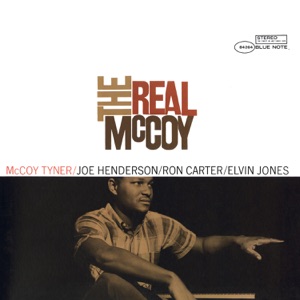
Jazz / Modal jazz · 1967
The Real McCoy
McCoy Tyner
Why listen
Five Tyner compositions give a familiar instrumental format a new centre of authorship.
Listen and read
Tracks · previews
English editorial edition
Album story
The Real McCoy begins a Blue Note chapter, not McCoy Tyner’s career as a leader. He had already made leader dates for Impulse while working with John Coltrane. That distinction makes this 1967 album more interesting: an established composer and pianist chooses another setting for his music, rather than suddenly stepping out of anonymity. The record gives five original pieces a deliberate sequence and a consistent quartet.
Joe Henderson plays tenor saxophone, Ron Carter bass and Elvin Jones drums. Jones brings a shared history with Tyner, but the saxophonist and bassist are not the other members of Coltrane’s classic quartet. Familiar instrumentation therefore creates room for different relationships. With Tyner supplying every composition, the album’s identity also rests on what the musicians are asked to play, not simply on the leader’s recognizable piano sound.
An expansive first side
The original first side contains only Passion Dance and Contemplation. Their lengths in the current delivery exceed eight and nine minutes respectively; the second piece is the longer one. The opening does not exhaust the album’s large scale. Instead, two substantial performances establish the first half, making a useful distinction between the force suggested by a dance and the inward turn suggested by contemplation.
Three pieces across the other side
Four By Five, Search for Peace and Blues on the Corner form the second side. Each lasts roughly six minutes, giving this half a different balance. Search for Peace is not the final destination. A blues follows it, so the programme leaves another kind of movement after its most explicitly peaceful title. The sequence resists a simple journey from intensity to permanent repose.
Writing for this quartet
One tenor voice sits alongside piano, bass and drums, without a trumpet completing a two-horn front line. That arrangement keeps the relationship between the keyboard and the single wind instrument central. Tyner’s leadership means providing the material in which all four can work. The closing blues belongs to that portrait as fully as the two long opening pieces: the new chapter accommodates several musical directions.
The album through its tracks
Compare the two long first-side pieces with the three shorter second-side pieces, keeping the blues after Search for Peace in the picture.
Passion Dance
The opening piece occupies almost nine minutes, presenting the quartet on a substantial scale before the album moves anywhere else. Its position matters as much as its reputation: this is the first of five compositions by the pianist, not a standard chosen to introduce his technique. Piano and tenor need not be heard as permanent background and foreground. They are two different resources within the same small ensemble. Contemplation, which follows, actually lasts longer. Thinking of Passion Dance as one of two large first-side performances allows the second piece equal structural weight, instead of treating everything after the opener as an appendix to a single celebrated statement.
Reference · Blue Note official store — original five compositions, LP sides and quartet personnelSearch for Peace
This is the fourth track and the middle piece on the original second side. Its title can suggest a conclusion, yet the album still has Blues on the Corner to come. That placement makes peace a particular point within the programme rather than its final, fixed condition. The quartet’s instrumentation remains the same, so contrast does not depend on bringing in an orchestra or adding another horn. The composition asks the existing ensemble to provide another character. Alongside Four By Five and the closing blues, it broadens the portrait of Tyner beyond forceful pianism, making the selection and ordering of his own material part of the musical argument.
Reference · Blue Note official store — original five compositions, LP sides and quartet personnel
Listen next
Return to A Love Supreme and compare its connected four-part design, with Coltrane and Jimmy Garrison alongside Tyner and Jones, with these five separate compositions.
A Love Supreme ↗References & editorial note
Written for English readers. Album facts are referenced below; listening suggestions are editorial interpretations. AI-assisted editorial review; not independently human-reviewed.
- Blue Note official store — original five compositions, LP sides and quartet personnel · store.bluenote.com
- Blue Note — McCoy Tyner biography and earlier Impulse leader dates · www.bluenote.com
- Blue Note — 1967 label debut in Tyner career account · www.bluenote.com
- Qobuz / Blue Note — complete five-track 2012 remaster and durations · www.qobuz.com
- Apple Music — current five-track Blue Note delivery · music.apple.com