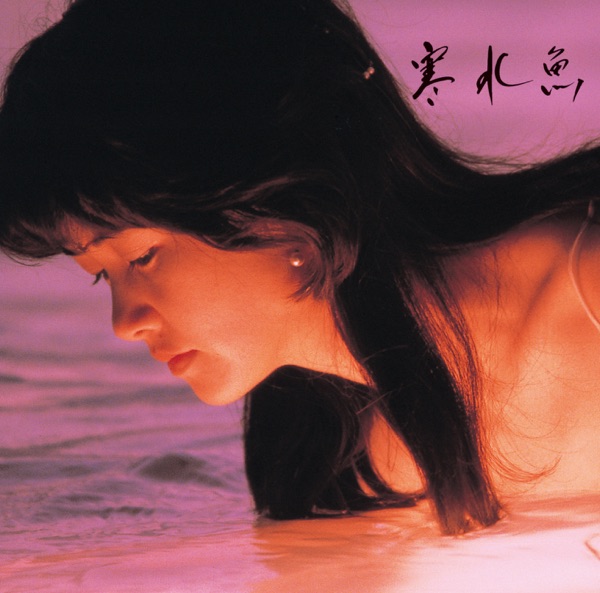
Japanese Music / Folk & songwriters · 1982
Kansuigyo
Miyuki Nakajima
寒水魚 · 中島みゆき
Why listen
A single voice changes the distance between direct address and expansive storytelling.
Listen and read
Tracks · previews
English editorial edition
Album story
Kansuigyo rewards attention to scale. Miyuki Nakajima can make a phrase feel like an immediate confrontation, then let another remain suspended over a much longer musical span. The continuity comes from her voice; the variety comes from the different positions that voice occupies inside each song.
Released on 21 March 1982, this was her ninth original album. The official catalogue names Nozomi Aoki, Tsugutoshi Goto and Masataka Matsutoya among its arrangers. The linked edition is the 2018 remaster of the nine-song programme. Its opening Akujo is the album version, distinct from the single, while its closing Utahime must not be confused with the later rerecording on the 2004 album Ima no Kimochi.
Follow the sentence
Rather than treating vocal intensity as a question of volume, notice what happens at the ends of phrases. A short ending can send the arrangement onwards; a sustained sound can make the next entrance feel delayed. These changes establish relationships between the singer and the surrounding music. They also allow successive songs to suggest different speakers without requiring an entirely different vocal identity.
Different amounts of time
The sequence moves through substantial performances such as Keisha and Suteru Hodo no Ai de Ii Kara without turning every track into the same kind of extended statement. B.G.M. and Iede give the programme different proportions. By the time Jikokuhyo and Suna no Fune lead into Utahime, duration itself has become part of the listening experience: some songs advance, while others ask the listener to remain with a thought.
Leave room for the speaker
It is tempting to hear every first-person song as autobiography. This record becomes more interesting when that assumption is relaxed. Listen first for the shape of the melody, then for the distance implied by the delivery. Even without understanding every Japanese word, contrasting phrase lengths provide an accessible route into the performances. Understanding more of the language can subsequently alter that first impression rather than simply confirm it.
The album through its tracks
Compare short phrase endings with sustained ones, keeping the accompaniment in view.
悪女
Akujo opens the record with a forceful sense of motion, but familiarity with the single should not settle expectations. Yamaha explicitly identifies this as the album version; the selected remaster runs about five minutes and twelve seconds. Begin by following the accompaniment, then notice how the voice pushes a sentence into that movement. At a held ending, listen for the changing distance to the next phrase. The title alone does not explain the relationship between speaker and performance. What matters here is how a familiar song acquires its own proportions within an album, establishing an energetic opening without defining the emotional range of everything that follows.
Reference · Yamaha official: 2018 remaster, album version of Akujo and separate 2004 rerecordings歌姫
Utahime closes the programme with more than eight minutes in which a vocal statement can leave a substantial afterimage. Resist waiting only for a large climax: remember the distance of the opening voice and compare it with later passages. The space after a phrase can become as useful a guide as the next melodic entrance. This selection belongs to the original album recording in remastered form. Yamaha separately identifies a rerecording on the 2004 album Ima no Kimochi, which is not the version linked here. Hearing the ending as an accumulation of time, rather than a list of dramatic events, helps explain its place after eight contrasting songs.
Reference · Yamaha official: 2018 remaster, album version of Akujo and separate 2004 rerecordings
Listen next
Continue with Akiko Yano’s JAPANESE GIRL and compare how a songwriter’s voice occupies the arrangement.
JAPANESE GIRL ↗References & editorial note
Written for English readers. Album facts are referenced below; listening suggestions are editorial interpretations. AI-assisted editorial review; not independently human-reviewed.