Film music / New Hollywood · 1960
Psycho
Bernard Herrmann
Psycho · 버나드 허먼
Why listen
A string orchestra turns repetition, silence and distance into suspense.
Listen and read
Tracks · previews
English editorial edition
Album story
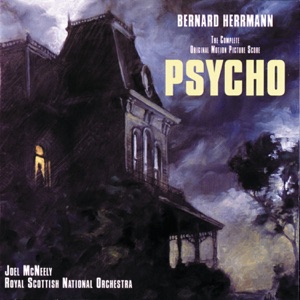
The strings in Psycho can strike sharply, then hold your attention with something almost motionless. The film and Bernard Herrmann’s score date from 1960. This listening edition is the rerecording released in 1997, conducted by Joel McNeely with the Royal Scottish National Orchestra, not the performances heard in the original film.
That distinction opens a useful way into the music. Freed from dialogue and images, the score reveals how much tension can grow from small gestures rather than an extended tune. This Varèse Sarabande programme separates the music into forty tracks. Follow their changing proportions before trying to turn each title into a remembered scene.
One family of instruments
Herrmann writes for strings, but uniform instrumentation does not mean uniform texture. A clipped chord and a sustained line ask for different kinds of attention; the distance between high and low parts can matter as much as loudness. Listen for what remains in the background after a more obvious gesture has ended. The quieter passages need not release the pressure. They may simply give your ear fewer clues about what will happen next.
Music beside the picture
The cue titles name people, places and actions, yet knowing the plot is not a requirement for hearing their contrasts. The Prelude establishes an urgent kind of movement that makes subsequent changes of pace especially noticeable. Album time is not film time, however. A sequence of rerecorded cues cannot reproduce the experience of music appearing among dialogue, sound effects and passages of silence. It offers a separate encounter with the writing, not a substitute soundtrack for synchronising with the picture.
Beyond the famous gesture
The Murder is an obvious landmark, but treating it as the whole score hides the quieter relationships around it. Begin at the Prelude and keep listening after the famous cue has passed. Notice how the memory of an abrupt attack changes the next sustained sound. This remains a compelling album because its limited instrumental palette keeps generating different expectations. McNeely and the orchestra provide a later recorded interpretation through which to explore those decisions, rather than an archive of the original film sessions.
The album through its tracks
Play the forty-track programme in order. The linked previews belong to the McNeely/RSNO rerecording released in 1997.
Prelude
The opening’s sharply separated chords make their own gaps part of the action. Speed matters, but so does the expectation created whenever a sound stops before the next one arrives. Follow the upper strings on your first pass, then shift attention to the lower parts. Does their persistence make the moving figures feel more urgent? Listen for changes of emphasis within what initially seems like a single repeated gesture. This is the McNeely and Royal Scottish National Orchestra performance, so avoid attributing film editing or sound effects to the recording itself. Without a picture, the cue still offers a vivid exercise in how recurring musical movements can keep anticipation unsettled.
Reference · Pearson: Psycho score study guideThe Murder
Its abrasive string gestures are immediately distinctive, but recognition can become a distraction. Once you have registered the attack, follow the relationship between registers and the spacing of successive sounds. Listen through the ending instead of letting a remembered image determine where your attention stops. Starting with the preceding Bathroom and continuing into The Body gives the cue a more revealing frame than constant isolated repetition. No detailed plot explanation is needed to hear that contrast. These previews use the rerecording released in 1997; they should not be taken as evidence of the original film performance’s exact timbre or synchronisation. The useful question here is how a short gesture changes the music around it.
Reference · Pearson: Psycho score study guide
Listen next
Continue with The Mission to hear a very different instrumental palette create space beyond the screen.
The Mission ↗References & editorial note
Written for English readers. Album facts are referenced below; listening suggestions are editorial interpretations. AI-assisted editorial review; not independently human-reviewed.
- Varèse Sarabande 35th anniversary programme, producer Robert Townson archive · roberttownson-productions.com
- Apple Music: Psycho, McNeely and RSNO · music.apple.com
- Pearson: Psycho score study guide · qualifications.pearson.com
- Pearson: specified recordings and catalogue numbers · qualifications.pearson.com
- SoundtrackINFO: Psycho re-recording, 1997 programme · www.soundtrackinfo.com