Film music / New Hollywood · 1974
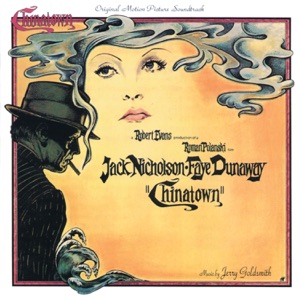
Chinatown
Jerry Goldsmith
Chinatown · 제리 골드스미스
Why listen
A singing trumpet line remains inviting while the sounds around it refuse complete reassurance.
Listen and read
Tracks · previews
English editorial edition
Album story
The trumpet melody is an immediate way into Chinatown, but it is not a complete description of Jerry Goldsmith’s music. Listen around that sustained line for shorter, less settled events. A tune can feel familiar while its surroundings remain difficult to trust. This relationship is available even without knowing the film: ask how stable the space behind the melody seems, and what happens when the melody stops.
The Geffen edition follows the twelve-track album programme associated with the 1974 film. Intrada’s documentation distinguishes that album presentation from the complete film score, including differences in editing and endings. This is therefore not a chronological account of every cue. Easy Living, I Can’t Get Started and The Way You Look Tonight are pre-existing standards, not new Goldsmith compositions. Their presence helps shape the listening sequence.
A line and its surroundings
In the opening Love Theme, follow the trumpet and then the resonance it leaves. The documented player is Uan Rasey. Long sounds and brief attacks establish different dimensions of space; neither must carry one fixed emotion. Rather than assigning beauty to the tune and fear to everything else, listen for the possibility that the same moment offers both. A graceful line need not resolve every tension in its accompaniment.
The order of an album
Noah Cross leads into the standard Easy Living, followed by Jake and Evelyn. Treat the transition as a comparison between musical surfaces rather than a precise timetable of events onscreen. Recognizable song forms and shorter dramatic pieces change the conditions under which the ear feels comfortable. You do not need a plot synopsis to notice whether an entrance is soft or abrupt, or how much room a lingering sound seems to occupy.
A return with a different memory
The love theme returns at the end. Hear it with the intervening pieces still in mind, without treating the opening and closing tracks as interchangeable. The reward today is not predicting a film’s conclusion but noticing how a lyrical line interacts with smaller events around it. Follow the trumpet once, then the sounds that remain during its pauses. The familiar theme becomes part of a more layered space. A separate complete-score programme can answer other questions; this album has its own proportions.
The album through its tracks
Compare the sustained trumpet with the brief sounds appearing around its pauses.
Love Theme from Chinatown (Main Title)
Follow the long trumpet line, then listen to what remains after a phrase has ended. Uan Rasey is named in the official personnel, but the immediate listening task is the contrast between a sustained instrument and shorter surrounding events. This is the opening Main Title in the twelve-track Geffen programme, not the closing End Title or a replacement from the complete-score presentation. An inviting melody need not make the whole background reassuring. During a pause, ask whether the resonance settles the space or leaves another tension active. On a second pass, give those smaller sounds priority; the same melodic phrase can seem nearer or farther away depending on what frames it.
Reference · Intrada: original album versus complete film score; personnel and source-song writersJake and Evelyn
The fourth track offers a useful change of scale after Easy Living. Listen for intervals between entrances rather than requiring a return of everything you remember from the main theme. This is the Geffen album track, not a claim that the identically titled cue in Intrada’s complete film score has the same edit. Two characters in a title do not require the listener to reconstruct every action in a scene. Attend to the overlap of long and short sounds, and to the place prepared for the next entrance when the texture thins. That provides a route through the piece without a plot summary. A short duration can still contain different kinds of waiting.
Reference · Intrada: original album versus complete film score; personnel and source-song writers
Listen next
Compare Planet of the Apes for another way Goldsmith uses instrumental placement to make an unfamiliar space.
Planet of the Apes ↗References & editorial note
Written for English readers. Album facts are referenced below; listening suggestions are editorial interpretations. AI-assisted editorial review; not independently human-reviewed.