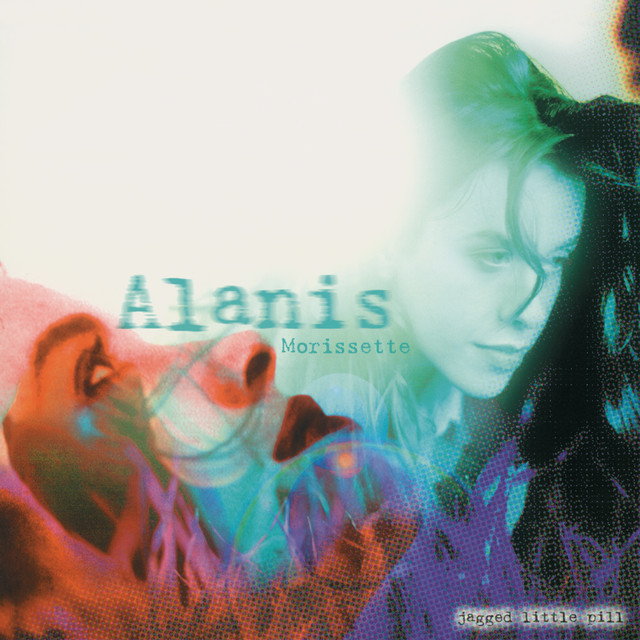
Pop / 1990s pop · 1995
Jagged Little Pill
Alanis Morissette
Why listen
Immediate vocal performances survive inside carefully assembled pop songs whose instrumental combinations change from track to track.
Listen and read
Tracks · previews
English editorial edition
Album story
You Oughta Know supplies one of Jagged Little Pill’s most forceful moments, but the songs around it prevent that anger from becoming the album’s only expression. Perfect follows with a different kind of pressure; Hand in My Pocket then offers a looser, circulating movement. Morissette’s sharply articulated words do not simply ride the same backing throughout. Their changing musical setting matters as much as their intensity.
Morissette and Glen Ballard share the writing credits for the first twelve songs, with Ballard producing the 1995 album. In a 1999 interview, he described retaining lead vocals recorded on the days the songs were written, then adding overdubs to the existing recordings. The process preserved an initial performance while allowing the arrangement to develop around it. Spontaneity and detailed studio work were therefore compatible parts of the record’s construction.
Different combinations beneath one voice
You Oughta Know brings together Flea on bass, Dave Navarro on guitar, Matt Laug on drums and Benmont Tench on organ. That lineup should not be projected across every song. Perfect uses a different instrumental combination, while Hand in My Pocket highlights Morissette’s harmonica alongside Ballard’s several roles. A consistent singer and writing partnership can accommodate noticeably different surfaces.
The second half broadens the mood
You Learn and Head over Feet move the later sequence away from a single confrontational stance. Mary Jane makes room for a longer breath before Ironic’s more compact phrases. Across these changes, a recognisable pop framework holds together speech-like delivery, sustained notes and sudden emphasis. The arrangements do not need to become louder at every turn to sustain the voice’s expressive range.
A concealed ending retained
After Wake Up, the original thirteenth entry combines the Jimmy the Saint Blend of You Oughta Know with the unaccompanied Your House. Returning to a familiar song in another form, then arriving at a voice without the band, changes the ending’s scale. Preserving that entry matters: the album’s final movement is more complicated than a sequence of its familiar singles.
The album through its tracks
Compare the distinct band parts of You Oughta Know with the harmonica and returning accompaniment of Hand in My Pocket.
You Oughta Know
The second track’s force depends on more than the singer’s attack. Flea’s bass and Navarro’s guitar occupy different lines, supported by Laug’s drums and Tench’s organ. That separation keeps the backing from becoming an undifferentiated wall underneath an intense vocal. Ballard’s account of preserving early performances also helps explain how an immediate delivery can coexist with an assembled instrumental setting. The production supports the raw quality instead of requiring the whole recording to be an unplanned outburst. This selection is the second-track version, not the concealed remix at the end. Its transition into Perfect reveals another kind of tension rather than simply prolonging the same emotional register.
Reference · Qobuz: licensed 2015 Collector’s Edition original disc and track-specific creditsHand in My Pocket
A returning accompaniment and Morissette’s harmonica give the fourth track its particular movement. Ballard’s guitar and keyboard contributions surround a vocal that shifts between conversational phrases and longer notes. Following the pressure of the preceding songs, the track offers a more flexible shape without abandoning the album’s directness. The harmonica continues a melodic line when the voice steps aside, making the instrumental passage part of the song’s conversation rather than an unrelated display. Its recurring framework also makes small changes of emphasis easy to notice. The attraction is not only a large chorus arriving, but the way the singer continually adjusts her phrasing within a readily recognisable pattern.
Reference · Qobuz: separate current twelve-track version and personnel
Listen next
Continue with Garbage’s debut from the same year to compare another meeting of a forceful singer and detailed studio construction.
Garbage ↗References & editorial note
Written for English readers. Album facts are referenced below; listening suggestions are editorial interpretations. AI-assisted editorial review; not independently human-reviewed.
- Rhino: official 2015 remaster programme, thirteen original entries and excluded extras · media.rhino.com
- Mix: Glen Ballard’s first-person account of preserving writing-day vocals · www.mixonline.com
- Qobuz: licensed 2015 Collector’s Edition original disc and track-specific credits · www.qobuz.com
- Rhino: original programme including hidden remix and additional track · www.rhino.com
- Apple Music: selected Deluxe Edition, original thirteen-track scope · music.apple.com
- Qobuz: separate current twelve-track version and personnel · www.qobuz.com