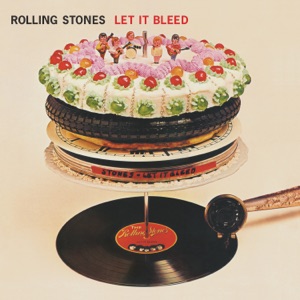
Rock / Psychedelia & studio experiments · 1969
Let It Bleed
The Rolling Stones
Why listen
Threat, intimacy and collective voices keep changing the scale of a rock band.
Listen and read
Tracks · previews
English editorial edition
Album story
The opening guitar of Let It Bleed feels less like a solid wall than air beginning to move. Yet the album does not sustain one shade of darkness for all nine tracks. Close voices, rough momentum and a spacious final chorus continually change the size of the scene.
Released late in 1969 and produced by Jimmy Miller, the album belongs to a period of personnel change. Both Brian Jones and Mick Taylor contribute, though that does not mean they share the same role throughout. Rather than making the record a single statement about the band’s fate, listen to the different musical distances it can accommodate.
More than abrasive rock
Hear Love in Vain and Country Honk immediately after Gimme Shelter. With the opener’s pressure still in the ear, a closer instrumental texture need not feel like simple relief. Blues and country approaches become ways for the band to redistribute weight, rather than decorative excursions outside rock. Country Honk is also not merely the single Honky Tonk Women inserted into the album under another name.
Who occupies the foreground?
Merry Clayton changes the vocal space of the opening track. Follow her as a distinct participant alongside Mick Jagger, not an anonymous layer behind him. Later, Keith Richards takes the lead vocal on You Got the Silver and establishes another kind of proximity. An album does not require one unchanging manner of address. Part of its continuity comes from hearing the accompaniment make room for these shifts in vocal character.
The final expansion
The London Bach Choir opens You Can’t Always Get What You Want on a scale unlike the preceding tracks. Compare that entrance with the movement of the band that follows. The choir is more interesting than a badge of grandeur: collective and individual voices give the same song different dimensions. Nor must the ending prove that every earlier anxiety has been resolved. The album remains absorbing because pressure and intimacy keep modifying each other through the running order. Return to the first guitar after the final track and notice how the intervening music has changed the distance from which you hear it.
The album through its tracks
Compare the opener and closer, then hear the smaller textures and changing voices between them in sequence.
Gimme Shelter
Do not let the opening guitar become merely a countdown to the famous singing. Remember the space established by its repeated figure, then compare what happens when Merry Clayton enters. Hearing Clayton and Mick Jagger as voices exchanging emphasis is more revealing than fixing one permanently in the background. A breath before a forceful note can matter as much as the note itself. On another pass, move attention away from the voices and follow how the rhythm supports their intensity. No private tragedy or speculative studio anecdote is needed to make the performance compelling. Finally, continue into the next song and listen for how much pressure from this opening remains in your ear.
Reference · ABKCO: Let It Bleed anniversary announcement and original programmeYou Can’t Always Get What You Want
The London Bach Choir establishes a large space before the band arrives. Follow the transition towards an individual voice and a more clearly grounded pulse: the song’s sense of distance changes as its forces change. Listen once for the choir and once for the way the rhythm finds its place. Grandeur need not be equated with an uncomplicated happy ending. The relationship between wanting and accepting can remain unsettled even as the music gathers momentum. This selection uses the long album version, not a single edit. Hear it after the preceding eight songs, allowing its duration to become part of the closing gesture rather than treating it as an isolated anthem.
Reference · ABKCO: Let It Bleed anniversary announcement and original programme
Listen next
Follow with the Beatles’ Abbey Road to compare the scale two bands give their closing sequences in 1969.
Abbey Road ↗References & editorial note
Written for English readers. Album facts are referenced below; listening suggestions are editorial interpretations. AI-assisted editorial review; not independently human-reviewed.