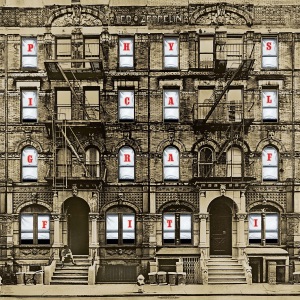
Rock / Hard rock & heavy metal · 1975
Physical Graffiti
Led Zeppelin
Why listen
Eight newer recordings and seven earlier outtakes become a double album whose scale changes sharply between electric expanses and acoustic miniatures.
Listen and read
Tracks · previews
English editorial edition
Album story
Physical Graffiti does not stretch one day’s mood across a longer record. New recordings and material left from earlier sessions acquire neighbours in a fresh sequence. An extended piece such as In My Time of Dying stands beside compact songs; In the Light is followed by a small acoustic instrumental. Arrangement across fifteen tracks matters as much as duration.
Released on February 24, 1975, the original programme combines eight newer tracks with seven previously unreleased recordings. The official session list reaches across several locations and the years 1970 to 1974. This is not a single-session document but an album that gives older material a new structural purpose. Houses of the Holy appears here as a song, rather than on the earlier album bearing that name. The selected edition contains the fifteen main tracks only.
Different kinds of propulsion
Custard Pie and The Rover lead into the lengthy In My Time of Dying. Houses of the Holy and Trampled Under Foot then precede Kashmir, closing the original first disc. This does not simply increase track length step by step. The funk movement of Trampled Under Foot and the broad recurring figure of Kashmir advance by different means. Forceful playing by the same band need not establish one universal stride.
A miniature after an expansive opening
The second disc opens with In the Light and contracts sharply into Bron-Yr-Aur. The acoustic instrumental occupies roughly two minutes without a vocal or an electric ensemble’s breadth. Treating it as empty space between major works misses a device that regulates the double album’s proportions. Down by the Seaside and Ten Years Gone then introduce other sizes of song. Extended electric passages, a miniature and sustained melodies can inhabit the same stretch of the programme.
Earlier material finds a new job
An omission from an earlier session need not remain an appendix here. From Night Flight to Sick Again, the closing run gathers shorter scenes after the large-scale pieces, including the contrasting textures of Boogie with Stu and Black Country Woman. Knowing the recordings’ different origins removes the need to imagine every transition planned at once. Selection and ordering are creative decisions. A return to the album can be about discovering the neighbours an older piece acquires, alongside revisiting the magnitude of its most celebrated tracks.
The album through its tracks
Keep In the Light, Bron-Yr-Aur and Down by the Seaside together to hear rapid changes of instrumentation and span.
Kashmir
Kashmir closes the original first disc and is track six in the selected audio, lasting about eight minutes thirty-seven seconds. Coming from Trampled Under Foot, its broad recurring figure establishes a different scale of advance. Instead of demanding a new melody at every turn, consider how the weight of a returning shape organises the piece. The figure can persist while singing and surrounding sonorities change its apparent size. Its geographical title need not be treated as evidence of a literal transcription of that place’s music. Hear the studio construction on its own terms. This is distinct from the companion disc’s Driving Through Kashmir rough orchestra mix and from concert recordings; its original closing position matters.
Reference · Apple Music: selected fifteen-track Remastered issueBron-Yr-Aur
This acoustic instrumental lasts approximately two minutes seven seconds. It is the second track of the original second disc, flattened to eighth in the digital list. After In the Light, the contraction from an extended electric scene can seem dramatic even without changing playback volume. Since no singer enters, accept the guitar’s small form as the composition rather than an introduction awaiting a vocal. It is a different work from the similarly named Bron-Y-Aur Stomp. The double album’s reuse of earlier recordings is visible even in this brief position. Continue into Down by the Seaside to preserve the route from broad ensemble to miniature and back to song. Placement gives short duration a substantial role.
Reference · Apple Music: selected fifteen-track Remastered issue
Listen next
Compare Led Zeppelin IV’s concentrated single-album design with this double album assembled from recordings of several periods.
Led Zeppelin IV ↗References & editorial note
Written for English readers. Album facts are referenced below; listening suggestions are editorial interpretations. AI-assisted editorial review; not independently human-reviewed.
- Led Zeppelin official discography:1975 release, fifteen tracks and sessions · discography.ledzeppelin.com
- Rhino: eight newer recordings and seven earlier unreleased tracks · www.rhino.com
- Led Zeppelin official2015 announcement: two-disc programme and seven distinct companion versions · www.ledzeppelin.com
- Apple Music: selected fifteen-track Remastered issue · music.apple.com