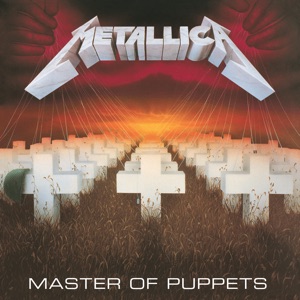
Rock / Hard rock & heavy metal · 1986
Master of Puppets
Metallica
Why listen
Contrasting textures receive room to develop between heavy riffs, while a substantial instrumental broadens the eight-track design.
Listen and read
Tracks · previews
English editorial edition
Album story
A quieter passage on Master of Puppets is not necessarily an empty wait for the next attack. If a song develops a changed texture, renewed heaviness acquires another meaning. Sustaining one intensity differs from passing through other material and returning to it. Rather than treating the album as an endurance test, consider how recurring guitar units connect and change, and what progression remains possible without a singer. Length then becomes a musical question rather than merely elapsed time.
Metallica recorded at Copenhagen’s Sweet Silence Studios from September through December 1985, co-producing with Flemming Rasmussen. This selection uses a standalone remaster of the original eight-track 1986 album, excluding the demos, work in progress and live recordings attached to expanded editions. A finished studio composition and evidence of its construction serve different purposes even when they share a title. The title track, Disposable Heroes and Orion each exceed eight minutes, without thereby becoming identical forms.
A riff is not the whole song
Think of a riff as a short, recognisable recurring unit. Remembering one differs from remembering the course built by several. In the title track, consider the instrumental middle and the route back towards weight. A new section matters through its distance from earlier material as well as its novelty. Returning to something familiar does not place the listener exactly where the song began.
An instrumental with its own responsibility
Orion has no sung text; its official writers include James Hetfield, Lars Ulrich and Cliff Burton. The instruments need not simply impersonate an absent singer. Their relationships can organise the extended span on other terms. Avoid assuming that bass must always remain a low line beneath guitar. Foreground and connection are roles that the same ensemble resources can occupy differently.
The ending after Orion
Damage, Inc. follows the seventh-track instrumental. Remembering Orion as the finale produces a different album ending. The actual closer is shorter than the preceding extended piece, but that does not make it an appendix. Compare the three long tracks through their neighbours and their positions rather than grouping them only by scale. Arrangement contributes to the album’s size.
The album through its tracks
Compare the title track’s instrumental middle with Orion’s vocal-free design, then continue to the actual closer, Damage, Inc.
Master of Puppets
The second track exceeds eight minutes in this edition. Do not take length to mean only an extended repetition of one riff: the instrumental middle deserves attention as substantial material. It is more than a corridor towards the next vocal entrance. When weight returns after a different texture, it forms another relationship than uninterrupted heaviness would have created. Rather than imagining a fresh beginning with every change, retain the preceding section in memory as the next develops. Naming every metre or analysing every riff is unnecessary. Notice whether familiar material seems to take on a changed role. Orion later offers a comparison between instrumental development inside a vocal piece and development carrying an entire track.
Reference · Library of Congress guest essay: instrumental development and contrasting dynamicsOrion
Seventh in sequence, this instrumental officially credits Hetfield, Ulrich and Burton as writers. It need not be heard as a display appended while the singer rests. Without words defining a situation, changing instrumental character and relationships become direct compositional resources. Avoid immediately identifying every prominent tone as guitar or assuming bass must always stand behind it. The same band members can foreground a gesture or connect one passage to another. Compare the title track’s middle with the responsibility of an independent instrumental. Then remember that Orion does not close the album. Damage, Inc. still follows, separating the emotional afterlife of one substantial piece from the placement of the actual finale. Both perspectives belong to hearing the record.
Reference · Metallica official: Orion is an instrumental, with Burton among its writers
Listen next
Compare the melodic voice and twin-guitar scenes of The Number of the Beast with this album’s riff connections and independent instrumental design.
The Number of the Beast ↗References & editorial note
Written for English readers. Album facts are referenced below; listening suggestions are editorial interpretations. AI-assisted editorial review; not independently human-reviewed.
- Metallica official: original eight tracks and production/remaster credits · www.metallica.com
- Metallica official: remastered main album separated from demos and live material · www.metallica.com
- Metallica official: Orion is an instrumental, with Burton among its writers · www.metallica.com
- Library of Congress guest essay: instrumental development and contrasting dynamics · www.loc.gov
- Apple Music: standalone eight-track remaster · music.apple.com