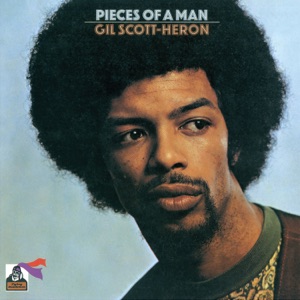
Soul / R&B / Singer-songwriter soul · 1971
Pieces of a Man
Gil Scott-Heron
Why listen
Spoken urgency, melodic tenderness and a jazz ensemble give social observation more than one musical form.
Listen and read
Tracks · previews
English editorial edition
Album story
Gil Scott-Heron speaks with precision here, but he also sings. Pieces of a Man moves between those activities, with Brian Jackson’s keyboards and an ensemble supplying more than a neutral backing. The famous opener sets one tone. It does not tell us everything about the ten original tracks still to come.
Following Small Talk at 125th and Lenox, the 1971 album expanded the setting to a band. Producer Bob Thiele brought together musicians including Ron Carter, Bernard Purdie, Hubert Laws and Burt Jones, with Johnny Pate also helping the session. Jackson was a composing partner as well as a keyboard player. The attractive personnel list matters less than what the musicians allow a phrase to become when it takes melodic shape.
After the declaration
The Revolution Will Not Be Televised gives way to Save the Children and Lady Day and John Coltrane. Their melodies establish that this will not be an album of identical addresses. Home Is Where the Hatred Is adds another perspective. Social observation can concern the scale of an individual predicament, rather than only a voice directed towards an imagined crowd. The variety is built into the sequence from the beginning.
Writing belongs to the arrangement
The first four songs credit Scott-Heron alone; the remaining seven original compositions credit him with Jackson. This distinction prevents the pianist from disappearing behind the singer’s reputation. Listen to a sentence as something carried by a melody and changing harmony, not merely printed language with decoration attached. An instrumental contribution may shape the time an observation occupies and the weight it acquires.
A different measure at the end
The original second side starts with the title song and ends with The Prisoner, which runs about nine minutes and twenty-six seconds in this delivery. That extended ending requires a different attention from the compact opening. Stop there on a first pass. The three subsequent Black & Blues recordings belong to an archival supplement from the college group, not the original conclusion. Preserving that boundary reveals an album able to contain compressed speech, lyrical release and prolonged tension without reducing them to a single manner of expression.
The album through its tracks
Keep the melodic songs after the opener in view, and pause after The Prisoner before hearing the three archival additions.
Lady Day and John Coltrane
The third track’s buoyancy offers another entrance for anyone expecting only forceful spoken statements. Its title refers to Billie Holiday and John Coltrane; it does not identify two guests at these sessions. Follow the energy the melody gives those names instead of hearing the song only as a list of admired musicians. At approximately three minutes and thirty-six seconds, recurring material stays close to the motion of the intervening words. Enjoying the rhythm need not prevent attention to their meaning. Continue into Home Is Where the Hatred Is: the contrast suggests room for another emotional possibility, rather than an attempt to erase the tensions elsewhere in the record.
Reference · Qobuz / Ace: fourteen-track programme, durations and composersPieces of a Man
Opening the original second side, the title song lasts approximately four minutes and fifty-four seconds in this edition. Its account of an individual damaged by the working world brings social observation down to a personal scale. Remember the shared Scott-Heron and Jackson writing credit and follow how the melody holds a sentence, rather than expecting the opener’s verbal pace. The impact comes partly from narrowing an institutional problem into the experience of one person. It need not be equated with the singer’s own biography or every listener’s circumstances. Arriving from I Think I’ll Call It Morning also places possibility beside the forces that threaten it, sharpening the contrast between neighbouring songs.
Reference · Ace / Flying Dutchman: original eleven-track LP and expanded CD distinction
Listen next
Continue with Curtis Mayfield’s Curtis to compare how public address and personal songs take different arranged forms within one album.
Curtis ↗References & editorial note
Written for English readers. Album facts are referenced below; listening suggestions are editorial interpretations. AI-assisted editorial review; not independently human-reviewed.
- Ace / Flying Dutchman: original eleven-track LP and expanded CD distinction · acerecords.co.uk
- Brian Jackson interview by Chris Williams, Wax Poetics (2022) · magazine.waxpoetics.com
- Brian Jackson interview, Reverb (2022) · reverb.com
- Qobuz / Ace: fourteen-track programme, durations and composers · www.qobuz.com
- Apple Music: Pieces of a Man, 2014 Ace expansion · music.apple.com
- Ace: expanded CD listing · acerecords.co.uk