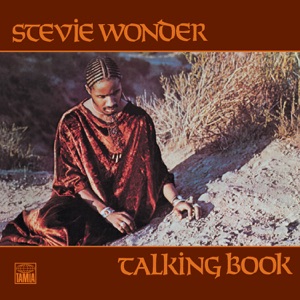
Soul / R&B / Singer-songwriter soul · 1972
Talking Book
Stevie Wonder
Why listen
Percussive keyboard parts and intricate love songs reveal very different sides of the same musical imagination.
Listen and read
Tracks · previews
English editorial edition
Album story
Talking Book follows the warmth of You Are the Sunshine of My Life with the extended unease of Maybe Your Baby. Affection never settles into a single tone. Stevie Wonder’s keyboards can cushion a melody or push sharply into the rhythm, and the contrast between those roles gives this album much of its character.
Released in 1972 after Music of My Mind, the ten-song album places Wonder at the centre as producer, singer and multi-instrumentalist. Robert Margouleff and Malcolm Cecil contributed associate production and engineering. Yet a record built through one musician’s many performances still has room for other voices and players. Its intimacy depends partly on those carefully arranged encounters.
Different kinds of keyboard
The opening song’s Rhodes and the clavinet in Superstition offer contrasting ways to organise a track. One can spread warmth beneath a melody; the other makes rhythm sharply tangible. Margouleff recalled keeping instruments ready so Wonder could move readily between them. That working method suggests a studio built around performance, with electronic instruments available as expressive tools rather than decorative signs of modernity.
Time inside a relationship
Maybe Your Baby lasts nearly seven minutes, making it the longest track. You and I and Tuesday Heartbreak then alter the scale again before the almost five-minute You’ve Got It Bad Girl closes the first side. The record does not simply alternate happy and sad songs. Its changing lengths allow attachment, doubt and reflection to occupy different amounts of space, complicating the apparent ease of the opening.
Another player answers
Superstition opens the second side with an unmistakable rhythmic presence. Big Brother and Blame It On the Sun move the sequence elsewhere before Jeff Beck’s guitar enters Lookin’ for Another Pure Love. Hear that contribution as another kind of reply within a song, rather than a detached guest showcase. I Believe follows to close the original programme. The final stretch demonstrates how a densely constructed studio album can still leave a meaningful place for another musician’s individual phrasing.
The album through its tracks
Compare the Rhodes at the opening, the clavinet opening side two, and the guitar responses near the end.
Superstition
The sixth track opens the original second side in its roughly four-minute twenty-six-second album form. Listen to the clavinet as part of the rhythmic machinery, not simply a keyboard supporting the singer. Margouleff recalled Wonder recording drums before adding the clavinet parts. That account helps explain the track as interacting performances rather than an automatic loop. Notice the small openings between those parts and the way a familiar vocal phrase enters their activity. After the longer first-side songs, this position gives the album a renewed point of departure. Stories involving Jeff Beck concern several recordings and recollections; the selection here is Wonder’s original studio album performance.
Reference · Robert Margouleff — direct interview with Bob Lefsetz, published transcriptLookin' for Another Pure Love
Jeff Beck’s guitar contribution to this ninth track is confirmed by the label. At roughly four minutes forty-four seconds, the song gives his phrasing space to answer Wonder’s voice without turning into an independent instrumental display. Follow the exchange between the vocal line and the different grain of the guitar. The placement matters too: Blame It On the Sun precedes it, while I Believe carries the album onwards to its close. Heard within that stretch, the guest appearance connects emotional scenes rather than interrupting them. Compared with Superstition’s tightly interlocking activity, these longer instrumental lines reveal another way of shaping space around a singer.
Reference · Universal Music Japan — Talking Book reissue, Jeff Beck participation on Another Pure Love
Listen next
Return to Music of My Mind, released earlier in the same year, to compare layered performances and the proportions of individual songs.
Music of My Mind ↗References & editorial note
Written for English readers. Album facts are referenced below; listening suggestions are editorial interpretations. AI-assisted editorial review; not independently human-reviewed.
- Universal Music Japan — original ten-song programme and keyboard descriptions · www.universal-music.co.jp
- Universal Music Japan — Talking Book reissue, Jeff Beck participation on Another Pure Love · www.universal-music.co.jp
- Robert Margouleff — direct interview with Bob Lefsetz, published transcript · www.iheart.com
- Motown / Qobuz — ten-track programme, production and vocal credits · www.qobuz.com
- Apple Music — Talking Book, public ten-track page · music.apple.com