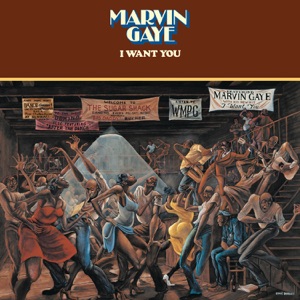
Soul / R&B / Disco & boogie · 1976
I Want You
Marvin Gaye
Why listen
Songs, instrumental passages and brief jams return familiar titles to different positions within an eleven-track sequence.
Listen and read
Tracks · previews
English editorial edition
Album story
Several titles recur in I Want You. The full opening song is distinct from two later short jams, while After the Dance appears first as an instrumental and finally as a vocal performance. Those returns make the track list more than eleven independent songs. Follow where the voice withdraws and reappears, and the album’s continuity becomes as interesting as any single melody.
Released in 1976, the album developed through Marvin Gaye’s partnership with Leon Ware. Ware later recalled the title-song demo reaching Gaye, followed by a proposal to collaborate more extensively. The licensed credits also identify Coleridge-Taylor Perkinson’s string arrangements and Art Stewart’s recording and mixing. These roles need not compete with the lead singer’s contribution. They provide different ways of shaping the surroundings in which his voice moves.
A spacious opening
Come Live with Me Angel follows the title song and exceeds six minutes, making it the longest track. After the Dance then arrives in instrumental form. That third position is not necessarily an empty pause between vocal statements. It introduces material that can remain in memory until the final performance. Keeping the two versions separate allows a listener to compare their roles instead of assuming that a repeated title indicates an interchangeable track.
The short spans matter
I Wanna Be Where You Are lasts around eighty seconds, followed by an introductory jam of approximately twenty. These proportions resist treating every numbered item as a full-length centrepiece. The programme contracts into a small connection before opening into another song. Skipping the brief passages changes that movement. Listen for what remains in memory as the available space becomes smaller and expands again.
Returning with a voice
All the Way Around, Since I Had You and Soon I’ll Be Loving You Again lead towards another title-song jam. The vocal After the Dance then closes the album. Remembering its earlier instrumental counterpart makes this ending a return as well as a destination. Rather than adding unrelated scenes indefinitely, the sequence revisits material under changed conditions. Track length and vocal presence offer concrete routes into that design, beyond simply describing a smooth overall mood.
The album through its tracks
Compare the opening title song and closing vocal After the Dance, then return to the third track’s instrumental version.
I Want You (Vocal)
The opening vocal performance lasts approximately four minutes and thirty-four seconds, distinct from the two short jams carrying its title. Credits place Ware’s rhythm arrangement beside Perkinson’s string and horn arrangements. Rather than treating those layers as one anonymous accompaniment, compare the moving foundation with the longer shapes around the voice. Attention can move between the sung line and smaller instrumental details without making either disappear. The title’s later returns also give this first performance a continuing role. It stands as a complete selection, while leaving a reference point inside the album. When a brief jam reappears, consider what its reduced length changes about that remembered material.
Reference · Qobuz / Motown: complete programme and production creditsAfter the Dance (Vocal)
The closing vocal version lasts approximately four minutes and thirty-seven seconds. It does not replace the instrumental placed third: both belong to the original programme. Remember that earlier appearance and notice how attention shifts when a voice occupies the familiar title’s space. Accompaniment has not ceased to matter; the relationship between its layers has acquired another centre. A short I Want You jam immediately precedes this longer ending, adding another change of proportion. Hear it as a conclusion reached through several returns, rather than making one song represent every mood on the record. Moving back to the instrumental afterwards makes the distinction especially tangible.
Reference · Qobuz / Motown: complete programme and production credits
Listen next
Continue with Let’s Get It On to compare the same singer’s placement of songs and returning material within another album.
Let's Get It On ↗References & editorial note
Written for English readers. Album facts are referenced below; listening suggestions are editorial interpretations. AI-assisted editorial review; not independently human-reviewed.
- Universal Music Japan: original eleven-track programme · www.universal-music.co.jp
- Red Bull Music Academy: direct Leon Ware and Janis Gaye interview · daily.redbullmusicacademy.com
- Qobuz / Motown: complete programme and production credits · www.qobuz.com
- Apple Music: current original eleven-track edition · music.apple.com