Classical / Baroque · 1959
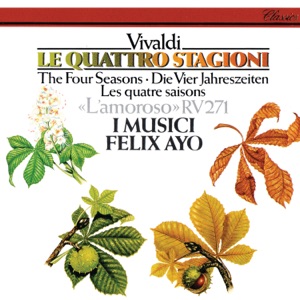
Vivaldi: The Four Seasons
I Musici / Felix Ayo
비발디: 사계 · 이 무지치 / 펠릭스 아요
Why listen
Look past the familiar opening tune to the changing relationship between one violin and the surrounding strings.
Listen and read
Tracks · previews
English editorial edition
Album story
Recognition is only the starting point. After the opening of Spring, follow what happens while the familiar material is absent, then notice how its return changes the scene. These concertos offer an accessible way to hear a soloist and an ensemble sharing responsibility for a musical narrative.
The recording here is the stereo performance made by Felix Ayo and I Musici in Vienna in 1959. They had already recorded the music in mono: matching artist names alone do not establish that two releases contain the same performance. The compositions belong to a much earlier history. Published in 1725 as the opening four concertos of Vivaldi’s Opus 8, each season has three movements. Four concertos are not four movements of a single symphony.
Listen for changing roles
The seasonal images can help, but identifying every bird or storm is not an entrance examination. Begin by distinguishing passages where the ensemble presents recognisable material from those where the violin takes another route. In the slow central movements, a change of pace also changes the scale of attention. A broad landscape can become a more intimate experience. The contrast between sustained melody and short accompaniment is often as revealing as the image assigned to a passage.
A recording within a longer history
Decca’s later account places Ayo’s successful stereo version within I Musici’s sequence of recordings. That does not mean this album invented interest in Vivaldi or gave the work its first performance. Colin Clarke’s 2001 reissue review criticised the pacing and weight of the accompaniment: later reception was not uniformly admiring. That assessment is not a report from 1959. This modern-instrument reading is useful as one perspective among many, rather than an instruction that every subsequent interpretation must sound like it.
Where this programme ends
The linked digital compilation contains fifteen tracks. The first twelve constitute The Four Seasons; the final three belong to the separate concerto L’amoroso, RV 271, recorded in 1958. Stop after the twelfth track once to preserve the boundary between works. The compilation’s 1986 date and the service’s individual track dates must not be confused with the 1959 recording sessions. Different release dates can describe the circulation of the same performance rather than a newly recorded interpretation.
The album through its tracks
Compare the opening movement of each concerto with its slow middle movement, following soloist and accompaniment separately.
Concerto for Violin and Strings in E Major, Op. 8, No. 1, RV 269 "La Primavera": 1. Allegro
Remember the opening ensemble statement, then listen into the space it leaves behind. The violin’s shorter gestures can suggest answering birds, but the movement remains interesting without turning each sound into a picture. Its familiar material returns after contrasting episodes, so the intervening solo writing changes how the return feels. Try following the surrounding strings rather than treating them as a backdrop for Ayo. Their entrances and withdrawals help define the size of each scene. You do not need to name every instrument to hear this exchange. Knowing the opening tune may simply make it easier to notice how much happens between its appearances.
Reference · LA Phil: publication and four concertosConcerto for Violin and Strings in F Minor, Op. 8, No. 4, RV 297 "L'inverno": 2. Largo
A sustained melodic line and short accompanying sounds allow two kinds of motion to coexist. The associated winter scene places rain outside and the listener’s imagined shelter indoors; warmth does not mean that the weather has stopped. Follow the violin first, then shift your attention to the accompaniment on another hearing. The same music can feel different depending on which layer seems closest. This is a useful way to hear a slow movement as an active arrangement of sounds rather than a pause in the action. Continue into the final movement afterwards to discover how strongly that sheltered moment contrasts with the movement around it.
Reference · Victoria Symphony: seasonal imagery and Winter
Listen next
Compare the distribution of solo and ensemble roles in Corelli’s concerti grossi.
Corelli: Concerti Grossi Op. 6 ↗References & editorial note
Written for English readers. Album facts are referenced below; listening suggestions are editorial interpretations. AI-assisted editorial review; not independently human-reviewed.
- TEAC/Esoteric: 1959 Vienna recording · eu.teac-audio.com
- Apple Classical: Ayo/I Musici 1959 recording in 1986 compilation · classical.music.apple.com
- MusicWeb 2001 reissue review and recording dates · musicweb-international.com
- LA Phil: publication and four concertos · www.laphil.com
- Victoria Symphony: seasonal imagery and Winter · victoriasymphony.ca
- Decca 2022 booklet: I Musici recording history · d24ku69pnn7av2.cloudfront.net