Classical / Baroque · 1973
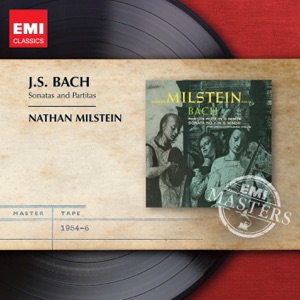
Bach: Sonatas and Partitas for Solo Violin
Nathan Milstein
바흐: 무반주 바이올린 소나타와 파르티타 · 나탄 밀스타인
Why listen
One violin suggests several voices while preserving the momentum of a continuous musical line.
Listen and read
Tracks · previews
English editorial edition
Album story
Listen to what remains after a note has stopped. A low pitch can continue to support the phrase in your memory while the violin has already moved upwards. Nathan Milstein makes that illusion of several voices feel like a living conversation rather than a demonstration of difficulty.
This is his 1973 London recording for Deutsche Grammophon of Bach’s six solo sonatas and partitas, BWV 1001–1006. It is distinct from the earlier Capitol cycle made in the 1950s. The music, the performance and its publication belong to different moments: Baroque compositions, a 1973 interpretation and a recording issued with 1975 phonographic rights. Keeping those layers separate helps identify what is actually being heard.
An ear for implied voices
A violin cannot sustain every chord tone as a keyboard can. It can spread a chord, move between registers and let the listener connect sounds across time. First follow the upper line; on another pass, notice where the lower notes return. Milstein’s continuity allows the separate gestures to belong to a larger phrase. You need not read a score to hear a reply or recognise the return of an idea.
Different kinds of movement
The sonatas’ slow openings and contrapuntal fugues offer a different experience from the dance movements in the partitas. A fugue can be approached as an idea returning at different pitches; a dance can be followed through its characteristic step. Neither needs to become an academic test. After hearing the great Ciaccona alone, return to the earlier movements of Partita No. 2 and notice how dramatically the finale enlarges their scale.
Recognition and later editions
The Recording Academy lists this cycle as a 1976 Grammy winner, evidence of recognition near its release rather than proof of unanimous critical agreement. DG’s 2019 reissue essay celebrates its clarity from a later perspective. The linked audio comes from the 2019 Complete Deutsche Grammophon collection: tracks 10–41 contain all thirty-two Bach movements. The surrounding concertos and recital pieces are not part of the six-work cycle. A 1998 CD and a 2019 vinyl edition are separate reissues; no claim is made that this digital collection uses the latter’s mastering.
The album through its tracks
Compare the Ciaccona with the E-major Preludio, moving from harmonic weight to continuous motion.
Partita For Violin Solo No. 2 in D Minor, BWV 1004: 5. Ciaccona
Rather than count variations, follow changes in weight. The opening establishes a harmonic presence that can survive while the violin’s surface becomes much more mobile. Firm chords and running figures give the same instrument different apparent dimensions. The brighter central region and the later return to darker colours provide landmarks for a first hearing. This performance lasts about fourteen minutes; the frequently repeated fifteen-minute description is not a fixed property of the work. Notice how earlier sounds remain in memory as the final pages arrive. The achievement is not simply sustaining a long solo, but making its changing textures belong to an intelligible span.
Reference · CiNii:DG1975rights/1973LondonrecordingPartita For Violin Solo No. 3 in E, BWV 1006: 1. Preludio
The quick succession of notes can initially seem like a single bright stream. Listen again for the small groups inside it: an accent, a change of register or a turn in direction gives the flow shape. Milstein does not need to interrupt the movement heavily to make those details perceptible. After the Ciaccona, this opening of the E-major Partita offers a markedly different balance of weight and momentum. Avoid treating it merely as a test of finger speed. The beginnings and endings of the tiny phrases matter too, because they determine how the next figure takes off. Follow the whole line first, then its internal punctuation.
Reference · CiNii:DG1975rights/1973Londonrecording
Listen next
Casals’s Bach cello suites provide a lower-register comparison for the interplay of melody and implied harmony.
Bach: Cello Suites ↗References & editorial note
Written for English readers. Album facts are referenced below; listening suggestions are editorial interpretations. AI-assisted editorial review; not independently human-reviewed.