Folk / Country / Alt-country & the 21st century · 1990
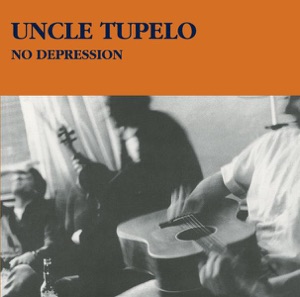
No Depression
Uncle Tupelo
Why listen
Forceful guitars, an inherited song and the sustained line of pedal steel turn everyday pressure into contrasting musical forms.
Listen and read
Tracks · previews
English editorial edition
Album story
No Depression does not begin by quietly restoring an old country song. Graveyard Shift opens, followed by That Year and Before I Break; only then does the title track arrive. The sequence places inherited material inside the force of a contemporary band. Instead of allocating one side to tradition and another to punk, the album lets short songs change the weight and pace of the same musicians.
Jay Farrar on guitar and vocals, Jeff Tweedy on bass and vocals, and drummer Mike Heidorn released their debut in 1990. Sean Slade and Paul Kolderie produced it. Kolderie later recalled using an eight-track machine within the available budget; Slade emphasized the combination of raw energy and tightly coordinated playing. Those accounts suggest hearing roughness as part of a captured performance rather than as an absence of preparation.
The title arrives fourth
No Depression, associated with the Carter Family, sits between Before I Break and Factory Belt. An older song receives the momentum of the opening tracks and hands it back to a contemporary original. Remember the compact returning phrases and compare their density with the neighbouring performances. The title song participates in the running order instead of standing outside it as a declaration.
A different line through Whiskey Bottle
Kolderie described replacing the demo’s harmonica with Rich Gilbert’s pedal steel. That production choice supplies a concrete way into the sixth track. Follow its sustained, bending line against the band’s continuing movement. The instruments need not all apply force in the same manner. A rhythm that holds its ground and a tone that stretches across it can create weight together. Outdone then changes the scale again.
Repeated beginnings in the second half
Train and Life Worth Livin’ lead toward Flatness, So Called Friend and Screen Door. These successive starts help sustain the album’s momentum. The thirteen-track configuration considered here adds John Hardy at the end, returning to an inherited narrative. A traditional song within the sequence and another at its conclusion perform different structural jobs. Listen for those placements and for the trio’s collective movement, beyond knowing which bands its members would later form.
The album through its tracks
Locate the fourth-track title song, follow the pedal steel in Whiskey Bottle, then compare the change of scale into Outdone.
No Depression
The fourth track lasts approximately two minutes and twenty seconds and brings a song associated with the Carter Family into the band’s own setting. Arrive here through the preceding three performances rather than expecting the album title to promise a succession of quiet country songs. Hear how returning phrases establish a compact form while the neighbouring tracks supply another kind of force. Familiar melody and the movement of a band occupy the same space. Continue into Factory Belt to hear how an inherited song travels beside contemporary originals. This is the original studio performance, distinct from the early demo later included among the reissue’s extras. Its location is as revealing as its familiar name.
Reference · Legacy Recordings: original thirteen-track programme, band and 2014 editionWhiskey Bottle
The sixth track runs approximately four minutes and forty-six seconds. Use Rich Gilbert’s pedal steel as a guide: follow a sustained bending tone while the rhythm beneath it continues to move. The vocal phrase and the instrumental line need not divide time in the same manner. Kolderie’s account of replacing the demo’s harmonica identifies a production decision that changes the song’s character, rather than merely adding decoration. Hear it after Factory Belt and before Outdone to understand the broader span it occupies within the album. The selected studio recording remains distinct from the demo and the live acoustic version that also appear on the expanded release under the same basic title.
Reference · No Depression: producers Sean Slade and Paul Kolderie recall the sessions
Listen next
Continue to Lucinda Williams’s Car Wheels on a Gravel Road and compare another production approach to country instrumentation and the force of a rock band.
Car Wheels on a Gravel Road ↗References & editorial note
Written for English readers. Album facts are referenced below; listening suggestions are editorial interpretations. AI-assisted editorial review; not independently human-reviewed.
- Legacy Recordings: original thirteen-track programme, band and 2014 edition · www.legacyrecordings.com
- No Depression: producers Sean Slade and Paul Kolderie recall the sessions · nodepression.org
- Qobuz / Columbia Legacy: original programme and separate demo/live versions · www.qobuz.com
- Apple Music: 2014 Legacy Edition with original thirteen-track opening programme · music.apple.com
- Music On Vinyl: twelve-track LP configuration · www.musiconvinyl.com