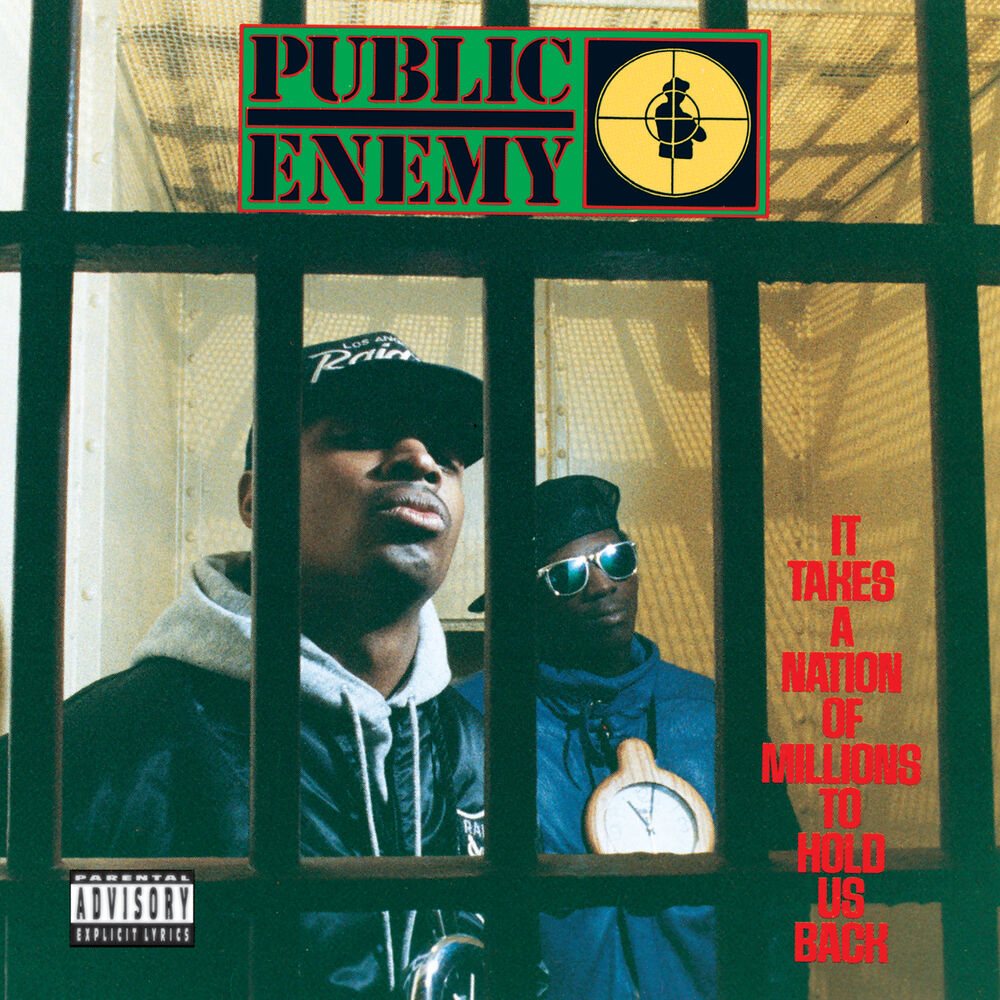
Hip-hop / Golden-age New York · 1988
It Takes a Nation of Millions to Hold Us Back
Public Enemy
Why listen
Chuck D’s firm delivery cuts through a crowded backing. Start with the friction between those layers, rather than treating the album as a history lesson you must pass.
Listen and read
Tracks · previews
English editorial edition
Album story
The backing will not politely step aside. In “Rebel Without a Pause”, a piercing repeated sound keeps demanding attention while Chuck D drives his sentences through it. That competition offers a way into It Takes a Nation of Millions to Hold Us Back even before you have caught every reference. Try following one layer, then the other: the same passage can feel surprisingly different.
Public Enemy’s second album arrived in 1988. This page follows the sixteen-track main programme, not an expanded deluxe edition. Its short introductions and linking pieces matter alongside the longer performances. The density of “Bring the Noise”, the change of personality in “Cold Lampin’ with Flavor”, and the extended storytelling later in the sequence give the record more movement than a description such as relentless protest might suggest.
More than one way to address a listener
Chuck D can sound as though he is addressing a room; Flavor Flav changes the distance, interrupting or answering rather than maintaining the same stance. Listen for those shifts before trying to untangle every reference. The Bomb Squad’s production also rewards divided attention. Sampling means reusing pieces of recorded sound, but here the useful question is what each piece does: hold the rhythm steady, interrupt it, or compete with the voice.
Admiration did not mean agreement
Greg Tate’s July 1988 Village Voice review praised the musical achievement while challenging discriminatory aspects of the group’s rhetoric. Contemporary reception was not simply unanimous acclaim. Keeping that distinction helps today: the record’s forceful assertion of Black identity invites historical attention without requiring uncritical agreement with every position expressed around it. Later recognition cannot substitute for that conversation.
Find an entrance, then return to the sequence
Begin with “Don’t Believe the Hype” and compare it with “Rebel Without a Pause”. Follow a recurring sound rather than reading while trying to hear everything. On a second visit, notice where the voice enters or leaves that pattern. Then return to the album order and keep the short transitions in place. They alter your anticipation of the next full track. Complexity becomes easier to enjoy once there is one familiar detail to return to.
The album through its tracks
Compare the returning refrain in Don’t Believe the Hype with the competing layers in Rebel Without a Pause. Previews are excerpts; use the linked services for the complete performances.
Don't Believe the Hype
The returning refrain gives you something to recognise even when the verses move beyond your grasp. Listen to the distance between that compact phrase and Chuck D’s longer sentences. Recalling the period in a 2018 KEXP interview, Hank Shocklee credited the response to DMC playing the demo outside the Apollo with encouraging its completion. This is a producer’s later recollection, not a survey of the audience. It nevertheless offers a useful contrast between studio judgement and public response. Try learning the refrain’s rhythm first, then hearing how the surrounding voices approach it. A forceful message can also leave an immediately accessible space for a listener to join.
Reference · KEXP: Hank Shocklee interview, 21 June 2018 (retrospective testimony)Rebel Without a Pause
A high repeated sound refuses to settle behind the rapper. In his 2018 KEXP recollection, Hank Shocklee described balancing the saxophone’s aggression against the intelligibility of Chuck D’s voice. That production problem is a helpful listening prompt: follow the voice once, then the upper layer, without increasing the volume. Notice how each changes your sense of the same beat. The arrangement makes room feel contested rather than comfortably allocated. You do not need to identify every source recording to experience that tension. Compared with a backing that simply supports a lead, this one seems to demand its own hearing, making the relationship between delivery and production unusually easy to notice.
Reference · KEXP: Hank Shocklee interview, 21 June 2018 (retrospective testimony)
Listen next
Follow this with Nas’s Illmatic for a closer, scene-setting narrative voice. Compare how a beat supports individual observation with the public address and interruptions heard here.
Illmatic ↗References & editorial note
Written for English readers. Album facts are referenced below; listening suggestions are editorial interpretations. AI-assisted editorial review; not independently human-reviewed.
- Public Enemy: official discography, original and deluxe editions · www.publicenemy.com
- Greg Tate: contemporary review, originally published 19 July 1988 · www.villagevoice.com
- KEXP: Hank Shocklee interview, 21 June 2018 (retrospective testimony) · www.kexp.org
- Apple Music: original 16-track programme and retrospective editorial · music.apple.com
- Tape Op: Hank Shocklee interviewed by Philip Stevenson, 2005 · tapeop.com