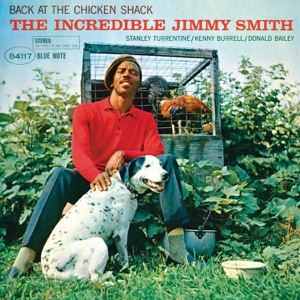
Jazz / Hard bop & Blue Note · 1963
Back at the Chicken Shack
Jimmy Smith
Why listen
Hammond organ changes the distribution of musical jobs, while contrasting tempos and extended performances reveal more than a single thick keyboard colour.
Listen and read
Tracks · previews
English editorial edition
Album story
If a jazz quartet suggests piano, bass, drums and a horn, Jimmy Smith offers a different arrangement of responsibilities. The organ is not simply a piano replaced by another colour. It can contribute to the low foundation while developing melodic material above it. Hear Back at the Chicken Shack with that distinction in mind: what establishes the rhythmic base, and what moves into the foreground?
Recorded on April 25, 1960 at Rudy Van Gelder’s studio, this 1963 album brings Smith together with tenor saxophonist Stanley Turrentine, guitarist Kenny Burrell and drummer Donald Bailey. The same session also produced Midnight Special, a separate album. This selection retains the original four-piece programme, excluding On the Sunny Side of the Street from the five-track digital issue. Recording date, album history and the current distribution should not be collapsed into one date or mastering claim.
More than a sustained background
Thinking of the Hammond only as a cushion of chords understates its role. Hands and feet can contribute to different registers, bringing together functions that another ensemble might divide between piano and bass. There is no need to guess which limb produces each low note. Instead, notice how the upper activity changes while a foundation continues. Thickness of sound and separation of musical functions can be heard together.
Two composers, different paces
Smith wrote the title track; Turrentine contributed Minor Chant. Before filing both under a general soul-jazz mood, compare their pace. The faster third track asks something different of the ensemble from the more settled opening. This is not a contest in speed. It is a way to hear how a continuing instrumental palette can support different conditions for improvisation, with Bailey’s drumming part of the action.
Four substantial performances
Four tracks do not mean four brief illustrations. Messy Bessie alone lasts more than twelve minutes, allowing the listener to remain inside a performance as its focus changes. Resist treating the title track as a summary of everything that follows. The additional digital track can be explored separately, but keeping the original ending in view makes the proportions of this particular album clearer.
The album through its tracks
Compare the title track with Minor Chant, attending to the organ’s low foundation and upper activity at their different paces.
Back at the Chicken Shack
Smith’s title track provides an entrance to both the organ’s weight and the ensemble’s movement. Rather than stopping at a description of thickness, notice what the upper line does while a low foundation is maintained. When tenor or guitar occupies the foreground, the organ’s continuing role still matters. Alternating between those layers and the combined result can reveal more than following each soloist alone. A slower pace need not mean an absence of activity: changing material within a steady motion is also development. Compare the performance with Minor Chant afterwards. The chosen track is the complete album opening in the Blue Note digital issue, not a single edit or a later concert rendition.
Reference · Blue Note artist feature: Hammond organ, personnel and individual piecesMinor Chant
Turrentine’s composition moves faster than the title track, providing a direct comparison within the same album. Speed is the starting point rather than the complete explanation. Attend to how tenor and organ come forward and to moments when the drums become especially apparent in the performance. The recurring presence of an organ need not make every track feel identical. Consider how the foundation noticed in the opener is experienced under these different conditions. The album’s longest piece, Messy Bessie, follows, so this energy is not the programme’s final destination. After comparing the two selected tracks, return to the original sequence to hear their different sizes and positions within the four-piece whole.
Reference · Blue Note artist feature: Hammond organ, personnel and individual pieces
Listen next
Continue with Dexter Gordon’s Go!, comparing this organ-centred setting with a quartet that divides keyboard and bass responsibilities between two players.
Go! ↗References & editorial note
Written for English readers. Album facts are referenced below; listening suggestions are editorial interpretations. AI-assisted editorial review; not independently human-reviewed.
- Blue Note official store: April25,1960 session and original four-track programme · store.bluenote.com
- Blue Note artist feature: Hammond organ, personnel and individual pieces · www.bluenote.com
- Apple Music: five-track Blue Note digital issue,1963 copyright · music.apple.com
- Cash Box February16,1963: contemporary Blue Note album advertisement · www.worldradiohistory.com