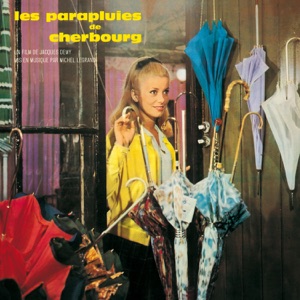
Film music / European auteur cinema · 1964
The Umbrellas of Cherbourg
Michel Legrand
The Umbrellas of Cherbourg · 미셸 르그랑
Why listen
Ordinary exchanges keep moving inside the melody, making conversation part of the musical action.
Listen and read
Tracks · previews
English editorial edition
Album story
You might expect an expansive opening melody to give way to ordinary spoken dialogue. In The Umbrellas of Cherbourg, the dialogue keeps singing. A question and its answer travel through the accompaniment without closing the musical world around them. Legrand’s attraction lies as much in those small connections as in the themes that became famous outside the film.
Jacques Demy wrote and directed the 1964 French film, following an umbrella-shop owner’s daughter, Geneviève, and a garage mechanic, Guy. Every line of dialogue is sung. The faces and singing voices are distinct: Danielle Licari sings Geneviève, played by Catherine Deneuve, while José Bartel sings Guy, played by Nino Castelnuovo. The recorded voice and the visible performance together create the character.
Conversation is musical action
Waiting only for a separate song to begin misses much of the design. Short vocal exchanges carry the progression themselves. Listen for the speed of a reply and for what the accompaniment does between speakers. You can follow that transfer of breath without understanding every French word, although vocal colour alone cannot supply the precise meaning of the dialogue. The film’s subtitles offer a different kind of access.
A recording that guided the image
Janus’s production history describes the completed vocal recording being played back during filming so the actors could synchronise their performances. On an album, the colours and gestures disappear, bringing the pace of the words into sharper focus. Returning to the film lets you compare how a body receives that rhythm. Neither experience replaces the other; they draw attention to different parts of the collaboration.
More than a familiar standard
The melody known through I Will Wait for You does not make that English title a separate track on this French soundtrack. Legrand later discussed how material from the score became independent English-language songs. The selected edition contains thirty tracks, running about 88 minutes from Générique to Final. Begin by connecting its first two tracks rather than treating it as a highlights collection. You can hear the unusual transition into everyday life without being told the ending in advance.
The album through its tracks
Continue directly from Générique into Scène du garage and hear an instrumental entrance become sung conversation.
Générique (Instrumental)
The first track opens the space without words. Its broad melody can hold your attention as an independent piece, but try listening with the next scene in mind. On the selected edition the title is Générique, not a separate item called Overture. Once the melodic outline has settled, continue into Scène du garage and notice the change when short human utterances enter that world. Follow the foreground melody on one pass, then the movement underneath it. No advance knowledge of the plot is needed. The interest is how much space the music prepares before dialogue arrives, and how that first impression may return differently when related melodic shapes appear later.
Reference · Apple Music US: thirty-track original soundtrack editionScène du garage
José Bartel’s voice brings everyday speech into the second track. Rather than waiting for a large solo number, listen to how one small utterance makes room for the next. Knowing that Bartel supplies Guy’s singing voice also explains why the album credit differs from the actor seen on screen. This is Scène du garage, not the separate eleventh track Devant le garage. Follow the conversational breaths first, then the accompaniment that keeps moving beneath them. The format need not become a novelty joke because the music does not stop the exchange from proceeding. An ordinary verbal rhythm and an emotionally suggestive melody can share a scene without becoming the same thing.
Reference · Apple Music US: thirty-track original soundtrack edition
Listen next
Amélie offers another relation between daily life and music: compare music beside dialogue with a film in which dialogue itself is sung.
Amélie ↗References & editorial note
Written for English readers. Album facts are referenced below; listening suggestions are editorial interpretations. AI-assisted editorial review; not independently human-reviewed.
- Janus Films: official production history and singing cast · s3.amazonaws.com
- Fresh Air: Michel Legrand interview recorded 1996, rebroadcast 1997 · freshairarchive.org
- Criterion Collection: film identity and musical format · www.criterion.com
- Apple Music US: thirty-track original soundtrack edition · music.apple.com