Film music / Jazz in film scores · 1951
A Streetcar Named Desire
Alex North
A Streetcar Named Desire · 알렉스 노스
Why listen
Jazz colours and orchestral lines give dramatic tension a physical, audible shape.
Listen and read
Tracks · previews
English editorial edition
Album story
Start with the friction between sounds, not with a synopsis. A firm wind phrase can press against a longer line, making a passage feel uneasy even when its melody is attractive. Alex North’s music for A Streetcar Named Desire invites that kind of close listening: atmosphere is also a relationship between people.
Elia Kazan’s 1951 film adapts Tennessee Williams’s play. The score brings jazz-inflected rhythm and instrumental colour into a composed dramatic setting. That does not turn the album into a jazz session built around extended solos. Its short sections work through changes of density, emphasis and direction. Without the images, you can follow those changes as a sequence of contrasting musical spaces, rather than trying to reconstruct every scene.
Listen around the melody
Try following a prominent line once, then concentrating on what supports it. Does the accompaniment make the phrase feel settled, or leave it exposed? This small comparison makes the emotional complexity accessible without specialist terminology. It also keeps the music from becoming a collection of labels such as romantic, tense or sad. A lyrical surface may contain pressure underneath. On record, the transition between two tracks can reveal that pressure as clearly as a close-up does on screen.
Different moments of recognition
North received an Academy Award nomination for the score in 1952; it was not a win. The original soundtrack was later included in the National Recording Registry’s 2015 selections. One is contemporary industry recognition, the other a preservation judgement made decades later. Neither requires a sweeping claim that this was the first or only film music to use jazz.
Know which performance is playing
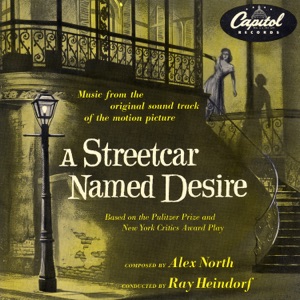
These previews use Capitol’s ten-track programme credited to Ray Heindorf and Alex North. The digital release carries a 2010 phonogram notice alongside its 1951 album date. The fifteen-track 1995 recording conducted by Jerry Goldsmith with the National Philharmonic Orchestra is a different performance, not simply this programme with extra tracks attached. Keeping the versions separate lets the original soundtrack retain its own scale and sound.
The album through its tracks
Compare the foreground in Streetcar with the balance between melody and accompaniment in Blanche.
Streetcar (Music From "A Streetcar Named Desire")
Treat the opening as a meeting of musical gestures rather than a postcard of New Orleans. Follow the wind line, then shift your attention to the sounds surrounding it. The supporting material helps determine how assertive or unsettled that line feels. On another pass, notice the ends of phrases and the spaces before a new gesture arrives. You can hear rhythmic elasticity without needing to name a jazz style. This is the opening track of the ten-piece soundtrack programme, not a title to substitute automatically for Main Title on a later recording. Different albums divide the material differently. Keep its profile in mind when the quieter selections arrive.
Reference · Apple Music: Ray Heindorf and Alex North, ten-track Capitol programmeBlanche (Music From "A Streetcar Named Desire")
The character’s name provides a point of attention, not an instruction to summarise her fate. Listen to how securely the melody sits above its accompaniment. Following the tune alone may suggest one emotional balance; including the surrounding sounds can suggest another. Ask whether a gentle passage feels protected or vulnerable, and allow the answer to remain open. No knowledge of the ending is necessary for that comparison. Try this after Streetcar, then restore the two intervening tracks. The approach to a character piece changes when its musical surroundings return. That difference shows how an album sequence can create its own dramatic experience, even without the film’s dialogue or images.
Reference · Apple Music: Ray Heindorf and Alex North, ten-track Capitol programme
Listen next
Continue with Miles Davis’s Ascenseur pour l’échafaud to compare another relationship between jazz performance and film.
Ascenseur pour l'échafaud ↗References & editorial note
Written for English readers. Album facts are referenced below; listening suggestions are editorial interpretations. AI-assisted editorial review; not independently human-reviewed.
- Apple Music: Ray Heindorf and Alex North, ten-track Capitol programme · music.apple.com
- Library of Congress: Jonathan Rhodes Lee, National Recording Registry essay · www.loc.gov
- Academy: 1952 award nominations · www.oscars.org
- John Stanley: 2008 reissue review · www.sfgate.com
- FilmMusic: 1995 Goldsmith rerecording credits · filmmusic.com