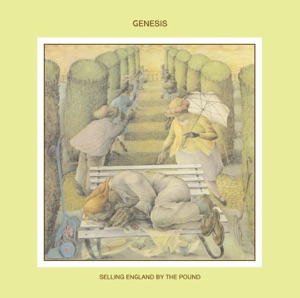
Rock / Progressive rock · 1973
Selling England by the Pound
Genesis
Why listen
Large instrumental scenes sit beside short songs, making duration and the changing singer part of the album’s proportions.
Listen and read
Tracks · previews
English editorial edition
Album story
The move from Firth of Fifth to More Fool Me provides a useful entrance to this record. A large instrumental scene gives way to a song on another scale. Remembering only the longest compositions can obscure what the short ones contribute. Compare a melody expanded through keyboards and guitar with a voice holding the centre of a concise track. Neither needs to win a contest for complexity; their neighbouring positions make both more distinctive.
Genesis released the album in 1973 with Peter Gabriel, Tony Banks, Steve Hackett, Mike Rutherford and Phil Collins. Gabriel does not account for every vocal: Collins sings lead on More Fool Me. The selected current eight-track issue is explicitly the 2007 Stereo Mix of the 1973 recording, a later remix with 2008 rights information. It is not presented as the original 1973 mix. The release year of the work and the identity of this distribution need to remain separate.
A melody changes its instrument
Firth of Fifth contains more than a celebrated guitar passage. Hear its piano, singing and instrumental development as a complete route. Hackett has recalled the melody passing through piano and flute before guitar became its vehicle. Different ways of sustaining a note can change a line’s character. Remembering what preceded the guitar makes the solo part of the construction rather than a detached attraction.
Leave room for the short songs
More Fool Me offers a different concentration immediately afterwards. Collins’s lead vocal belongs to a concise form, not simply a waiting area before another extended composition. Elsewhere, After the Ordeal sits between The Battle of Epping Forest and The Cinema Show, while the brief Aisle of Plenty closes the programme. Track length describes the album’s balance, not a hierarchy of artistic value.
From narrative to instrumental movement
An English setting does not turn every track into the same story. Following a sung scene and following an instrumental development offer different pleasures. Compare where the voice retains attention with where the instruments take over. The changing scale across eight tracks is worth experiencing before attempting to decode every image or rhythmic pattern. The arrangement of the pieces gives the album a concrete shape.
The album through its tracks
Compare Firth of Fifth with the following More Fool Me, then follow the differing lengths across all eight tracks.
Firth of Fifth
Rather than waiting only for the familiar guitar passage, begin with the scale established by the piano. Hackett’s recollection invites attention to a melody finding a different character through different instruments. When the guitar sustains its line, consider how the memory of earlier material contributes. Playing many rapid notes and giving a long note direction are different choices; this passage offers a way to think about the latter. Do not let the celebrated guitar erase singing, keyboards or rhythm from the route that leads there. This is the complete track in the 2007 stereo remix, not a later Hackett solo concert performance or a re-recording of the composition.
Reference · Steve Hackett official-hosted Guitar Player interview: Firth of Fifth melody and guitarMore Fool Me
Phil Collins takes the lead vocal here, changing the perspective after the extended instrumental scale of the preceding track. Notice what stays in the foreground when a song occupies less time. A concise vocal form asks for another kind of concentration from a piece built around multiple large transitions. Calling it less important because it is shorter misses its role in the album’s proportions. Hear it after Firth of Fifth, then consider how it feels when played alone. It also makes the album’s use of more than one lead singer concrete. The selection belongs to the same eight-track 2007 stereo remix; its mix date is distinct from the original release year.
Reference · Qobuz / Rhino: 2007 Stereo Mix track order, complete durations and performance credits
Listen next
Continue with Yes’s Close to the Edge and compare contrasts across eight track lengths with an album constructed from three extended pieces.
Close to the Edge ↗References & editorial note
Written for English readers. Album facts are referenced below; listening suggestions are editorial interpretations. AI-assisted editorial review; not independently human-reviewed.
- Genesis official store: 1973 album and later Nick Davis/Genesis mix · store.genesis-music.com
- Qobuz / Rhino: 2007 Stereo Mix track order, complete durations and performance credits · www.qobuz.com
- Steve Hackett official-hosted Guitar Player interview: Firth of Fifth melody and guitar · www.hackettsongs.com
- Apple Music: explicitly identified 2007 Stereo Mix · music.apple.com
- Qobuz: separate original-era distribution for edition comparison · www.qobuz.com